Advertisements
Advertisements
Question
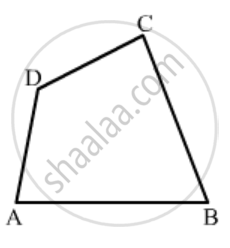
In Fig. 16.19, ABCD is a quadrilateral.
Name a pair of opposite sides.
Advertisements
Solution
\[\text{ (AB, CD) or (BC, DA) } \]
RELATED QUESTIONS
Define the following term Convex Quadrilateral .
Complete of the following, so as to make a true statement:
A quadrilateral has ..... vertices, no three of which are .....
In a convex hexagon, prove that the sum of all interior angle is equal to twice the sum of its exterior angles formed by producing the sides in the same order.
Two angles of a quadrilateral are 89° and 113°. If the other two angles are equal; find the equal angles.
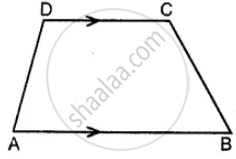
The following figure shows a quadrilateral in which sides AB and DC are parallel. If ∠A : ∠D = 4 : 5, ∠B = (3x – 15)° and ∠C = (4x + 20)°, find each angle of the quadrilateral ABCD.
In the following figure, What is AE + EC?

What conclusion can be drawn from part of given figure, if DC is the bisector of ∠ADB, CA ⊥ DA and CB ⊥ DB?

Draw a rough sketch of a quadrilateral KLMN. State two pairs of adjacent angles.
Investigate :
Use strips and fasteners to make a triangle and a quadrilateral.
Try to push inward at any one vertex of the triangle. Do the same to the quadrilateral. Is the triangle distorted? Is the quadrilateral distorted? Is the triangle rigid?
Why is it that structures like electric towers make use of triangular shapes and not quadrilaterals?
Which of the following is a key requirement for correctly naming a □ABCD?
