Advertisements
Advertisements
Question
Two adjacent angles of a parallelogram are 70° and 110° respectively. Find the other two angles of it.
Advertisements
Solution
Given two adjacent angles of a parallelogram are 70° and 110° respectively.
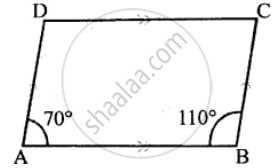
Since, we know that opposite angles of a parallelogram are equal
∴∠C = ∠A = 70° and ∠D = ∠B = 110°
APPEARS IN
RELATED QUESTIONS
The perimeter of a parallelogram is 22 cm . If the longer side measures 6.5 cm what is the measure of the shorter side?
In a quadrilateral, define of the following Exterior .
Complete of the following, so as to make a true statement:
A quadrilateral has ....... sides.
Complete of the following, so as to make a true statement:
The sum of the angles of a quadrilateral is ......
Complete of the following, so as to make a true statement:
In a quadrilateral the point of intersection of the diagonals lies in .... of the quadrilateral.
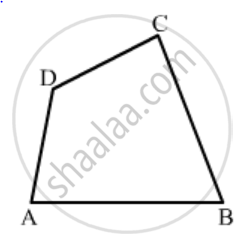
In Fig. 16.19, ABCD is a quadrilateral.
Name a pair of opposite angles.
Complete the following statement by means of one of those given in brackets against each:
f consecutive sides of a parallelogram are equal, then it is necessarily a ..................
Observe the figure below and find out their name.

Three angles of a quadrilateral are 75º, 90º and 75º. The fourth angle is ______.
Using the information given, name the right angles in part of figure:
RT ⊥ ST

