Advertisements
Advertisements
प्रश्न
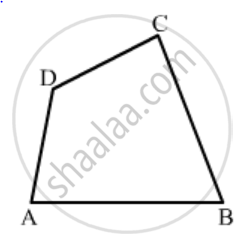
In Fig. 16.19, ABCD is a quadrilateral.
Name a pair of opposite angles.
Advertisements
उत्तर
\[ \text{ (∠A, ∠C) or (∠B, ∠D) } \]
संबंधित प्रश्न
In a quadrilateral, define of the following Diagonals .
In a quadrilateral, define of the following Exterior .
Complete the following statement by means of one of those given in brackets against each:
A line drawn from the mid-point of one side of a triangle .............. another side intersects the third side at its mid-point.
Two adjacent angles of a parallelogram are 70° and 110° respectively. Find the other two angles of it.
In quadrilateral WXYZ, the pairs of opposite angles are ______.
Both the pairs of opposite angles of a quadrilateral are equal and supplementary. Find the measure of each angle.
In the following figure, name any two angles that appear to be obtuse angles.

What conclusion can be drawn from part of given figure, if DB is the bisector of ∠ADC?

Draw a rough sketch of a quadrilateral KLMN. State two pairs of opposite sides.
Which of the following represents the vertices of quadrilateral ABCD?
