Advertisements
Advertisements
प्रश्न
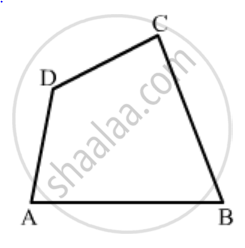
Given : In quadrilateral ABCD ; ∠C = 64°, ∠D = ∠C – 8° ; ∠A = 5(a+2)° and ∠B = 2(2a+7)°.
Calculate ∠A.
Advertisements
उत्तर
∵ ∠C = 64° (Given)
∴ ∠D = ∠C – 8° = 64°- 8° = 56°
∠A = 5(a+2)°
∠B = 2(2a+7)°
Now ∠A + ∠B + ∠C + ∠D = 360°
5(a+2)° + 2(2a+7)° + 64° + 56° = 360°
5a + 10 + 4a + 14° + 64° + 56° = 360°
9a + 144° = 360°
9a = 360° – 144°
9a = 216°
a = 24°
∴ ∠A = 5 (a + 2) = 5(24+2) = 130°
संबंधित प्रश्न
In a quadrilateral, define of the following Opposite angles .
Complete of the following, so as to make a true statement:
In a quadrilateral the point of intersection of the diagonals lies in .... of the quadrilateral.
In Fig. 16.19, ABCD is a quadrilateral.
How many pairs of adjacent angles are there?
The four angles of a quadrilateral are as 3 : 5 : 7 : 9. Find the angles.
The sides of a quadrilateral are produced in order. What is the sum of the four exterior angles?
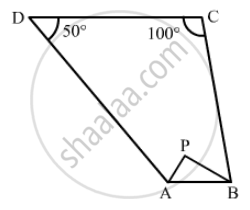
In Fig. 16.21, the bisectors of ∠A and ∠B meet at a point P. If ∠C = 100° and ∠D = 50°, find the measure of ∠APB.
The angles A, B, C and D of a trapezium ABCD are in the ratio 3: 4: 5: 6. Le. ∠A : ∠B : ∠C : ∠D = 3:4: 5 : 6. Find all the angles of the trapezium. Also, name the two sides of this trapezium which are parallel to each other. Give reason for your answer.
In an isosceles trapezium one pair of opposite sides are _____ to each Other and the other pair of opposite sides are _____ to each other.
Two opposite angles of a parallelogram are 100° each. Find each of the other two opposite angles.
The angles A, B, C and D of a quadrilateral are in the ratio 2 : 3 : 2 : 3. Show this quadrilateral is a parallelogram.
Observe the figure below and find out their name.

In a pentagon ABCDE, AB || ED and ∠B = 140°, ∠C = 2x° and ∠D = 3x°. Find ∠C and ∠D
ΔPQR and ΔSQR are on the same base QR with P and S on opposite sides of line QR, such that area of ΔPQR is equal to the area of ΔSQR. Show that QR bisects PS.
Three angles of a quadrilateral are 75º, 90º and 75º. The fourth angle is ______.
ABCD is a rhombus such that ∠ACB = 40º. Then ∠ADB is ______.
If APB and CQD are two parallel lines, then the bisectors of the angles APQ, BPQ, CQP and PQD form ______.
In the following figure, ∠XYZ cannot be written as ______.

Using the information given, name the right angles in part of figure:
AC ⊥ BD

What conclusion can be drawn from part of given figure, if DB is the bisector of ∠ADC?

What conclusion can be drawn from part of given figure, if DC is the bisector of ∠ADB, CA ⊥ DA and CB ⊥ DB?

