Advertisements
Advertisements
प्रश्न
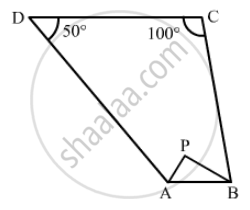
In Fig. 16.21, the bisectors of ∠A and ∠B meet at a point P. If ∠C = 100° and ∠D = 50°, find the measure of ∠APB.
Advertisements
उत्तर
\[∠A + ∠B + ∠C +∠D = 360° \]
\[ \Rightarrow ∠A +∠B + 100°+ 50° = 360° \]
\[ \Rightarrow ∠A + ∠B = 210° . . . (i)\]
\[\text{ In } \bigtriangleup APB, \text{ we have } : \]
\[\frac{1}{2}∠A + \frac{1}{2}∠B + ∠APB = 180° \]
\[ \Rightarrow ∠APB = 180° - \frac{1}{2}\left( ∠A + ∠B \right)\]
\[\text{ From (i), we get: } \]
\[ \Rightarrow ∠APB = 180° - \left( \frac{1}{2} \times 210° \right) \]
\[ \therefore ∠APB = 75° \]
संबंधित प्रश्न
Complete of the following, so as to make a true statement:
The measure of each angle of a convex quadrilateral is ..... 180°.
The angles of a quadrilateral are 110°, 72°, 55° and x°. Find the value of x.
In a quadrilateral ABCD, CO and DO are the bisectors of ∠C and ∠D respectively. Prove that \[∠COD = \frac{1}{2}(∠A + ∠B) .\]
Mark the correct alternative in each of the following:
The opposite sides of a quadrilateral have
If angles A, B, C and D of the quadrilateral ABCD, taken in order, are in the ratio 3 : 7 : 6 : 4, then ABCD is a ______.
Number of angles less than 180° in the following figure is ______ and their names are ______.

In the following figure, name any two angles that appear to be obtuse angles.

Using the information given, name the right angles in part of figure:
AC ⊥ CD

Draw a rough sketch of a quadrilateral KLMN. State two pairs of opposite sides.
Draw a rough sketch of a quadrilateral KLMN. State two pairs of adjacent sides.
