Advertisements
Advertisements
प्रश्न
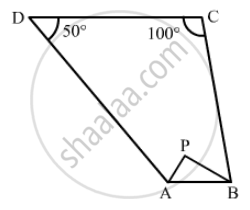
In Fig. 16.21, the bisectors of ∠A and ∠B meet at a point P. If ∠C = 100° and ∠D = 50°, find the measure of ∠APB.
Advertisements
उत्तर
\[∠A + ∠B + ∠C +∠D = 360° \]
\[ \Rightarrow ∠A +∠B + 100°+ 50° = 360° \]
\[ \Rightarrow ∠A + ∠B = 210° . . . (i)\]
\[\text{ In } \bigtriangleup APB, \text{ we have } : \]
\[\frac{1}{2}∠A + \frac{1}{2}∠B + ∠APB = 180° \]
\[ \Rightarrow ∠APB = 180° - \frac{1}{2}\left( ∠A + ∠B \right)\]
\[\text{ From (i), we get: } \]
\[ \Rightarrow ∠APB = 180° - \left( \frac{1}{2} \times 210° \right) \]
\[ \therefore ∠APB = 75° \]
संबंधित प्रश्न
In a quadrilateral, define of the following Interior .
Complete of the following, so as to make a true statement:
In a quadrilateral the point of intersection of the diagonals lies in .... of the quadrilateral.
Complete of the following, so as to make a true statement:
A quadrilateral is convex if, for each side, the remaining ______ lie on the same side of the line containing the side.
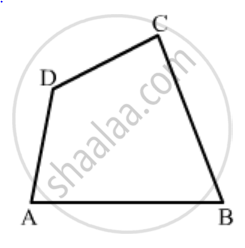
In Fig. 16.19, ABCD is a quadrilateral.
How many pairs of adjacent angles are there?
If the sum of the two angles of a quadrilateral is 180°. What is the sum of the remaining two angles?
One angle of a pentagon is 160° and the rest are all equal angles. Find the measure of the equal angles.
If a bicycle wheel has 48 spokes, then the angle between a pair of two consecutive spokes is ______.
Number of angles less than 180° in the following figure is ______ and their names are ______.

In the following figure, What is AC – EC?

Using the information given, name the right angles in part of figure:
AC ⊥ BD

