Advertisements
Advertisements
प्रश्न
The angles of a quadrilateral are 110°, 72°, 55° and x°. Find the value of x.
Advertisements
उत्तर
\[\text{ The sum of anlges of a quadilateral is } 360°. \]
\[\text{ So, we get } 110° + 72° + 55° + x = 360° \]
\[ \Rightarrow 237°+ x = 360° \]
\[ \Rightarrow x = 360° - 237° \]
\[ \therefore x = 123° \]
संबंधित प्रश्न
In a quadrilateral, define of the following Sides.
Complete of the following, so as to make a true statement:
The measure of each angle of a convex quadrilateral is ..... 180°.
In Fig. 16.19, ABCD is a quadrilateral.
How many pairs of opposite sides are there?
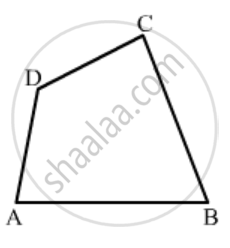
In Fig. 16.19, ABCD is a quadrilateral.
Name a pair of adjacent angles.
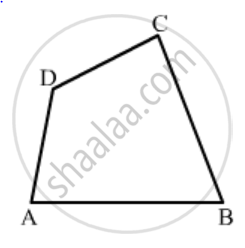
The four angles of a quadrilateral are as 3 : 5 : 7 : 9. Find the angles.
If the sum of the two angles of a quadrilateral is 180°. What is the sum of the remaining two angles?
If the bisectors of two adjacent angles A and B of a quadrilateral ABCD intersect at a point O such that ∠C + ∠D = k ∠AOB, then find the value of k.
Two angles of a quadrilateral are 68° and 76°. If the other two angles are in the ratio 5 : 7; find the measure of each of them.
The angles of a quadrilateral are in the ratio 2 : 4 : 5 : 7. Find all the angles
In quadrilateral HOPE, the pairs of opposite sides are ______.
