Advertisements
Advertisements
प्रश्न
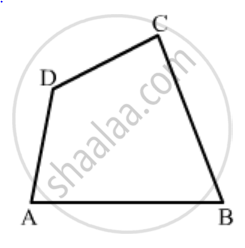
Given : In quadrilateral ABCD ; ∠C = 64°, ∠D = ∠C – 8° ; ∠A = 5(a+2)° and ∠B = 2(2a+7)°.
Calculate ∠A.
Advertisements
उत्तर
∵ ∠C = 64° (Given)
∴ ∠D = ∠C – 8° = 64°- 8° = 56°
∠A = 5(a+2)°
∠B = 2(2a+7)°
Now ∠A + ∠B + ∠C + ∠D = 360°
5(a+2)° + 2(2a+7)° + 64° + 56° = 360°
5a + 10 + 4a + 14° + 64° + 56° = 360°
9a + 144° = 360°
9a = 360° – 144°
9a = 216°
a = 24°
∴ ∠A = 5 (a + 2) = 5(24+2) = 130°
संबंधित प्रश्न
Define the following term Quadrilateral .
In a quadrilateral, define of the following Vertices .
In a quadrilateral, define of the following Opposite angles .
Complete of the following, so as to make a true statement:
A quadrilateral has ....... sides.
Complete of the following, so as to make a true statement:
A quadrilateral has .... diagonals.
Complete of the following, so as to make a true statement:
The measure of each angle of a convex quadrilateral is ..... 180°.
In Fig. 16.19, ABCD is a quadrilateral.
How many pairs of adjacent angles are there?
The angles of a quadrilateral are 110°, 72°, 55° and x°. Find the value of x.
Complete the following statement by means of one of those given in brackets against each:
f consecutive sides of a parallelogram are equal, then it is necessarily a ..................
If ABCD is a rectangle with ∠BAC = 32°, find the measure of ∠DBC.
If the bisectors of two adjacent angles A and B of a quadrilateral ABCD intersect at a point O such that ∠C + ∠D = k ∠AOB, then find the value of k.
If three angles of a quadrilateral are 90° each, show that the given quadrilateral is a rectangle.
Find the angles of a quadrilateral whose angles are in the ratio 1: 4: 5: 2.
The angles of a pentagon are x°, (x - 10)°, (x + 20)°, (2x - 44)° and (2x - 70)°. Find the angles.
Calculate the measure of each angle of a nonagon.
In a quadrilateral ABCD, ∠A = 72° and ∠C is the supplementary of ∠A. The other two angles are 2x – 10 and x + 4. Find the value of x and the measure of all the angles
D and E are the mid-points of the sides AB and AC respectively of ∆ABC. DE is produced to F. To prove that CF is equal and parallel to DA, we need an additional information which is ______.
Measures of the two angles between hour and minute hands of a clock at 9 O’ clock are ______.
The number of right angles in a straight angle is ______ and that in a complete angle is ______.
