Advertisements
Advertisements
प्रश्न
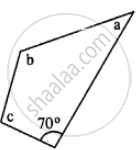
In the given figure : ∠b = 2a + 15 and ∠c = 3a + 5; find the values of b and c.
Advertisements
उत्तर
∵ Sum of angles of quadrilateral = 360°
70° + a + 2a + 15 + 3a + 5 = 360°
6a + 90° = 360°
6a = 270°
a = 45°
∴ b = 2a + 15 = 2 x 45 + 15 = 105°
c = 3a + 5 = 3 x 45 + 5 = 140°
Hence ∠b and ∠c are 105° and 140°
संबंधित प्रश्न
In a quadrilateral, define of the following Angles .
Complete of the following, so as to make a true statement:
The sum of the angles of a quadrilateral is ......
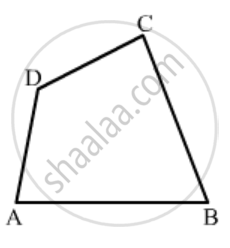
In Fig. 16.19, ABCD is a quadrilateral.
Name a pair of adjacent sides.
In Fig. 16.19, ABCD is a quadrilateral.
Name a pair of adjacent angles.
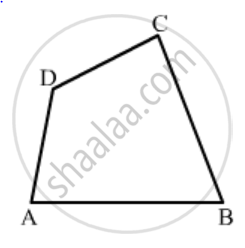
In Fig. 16.19, ABCD is a quadrilateral.
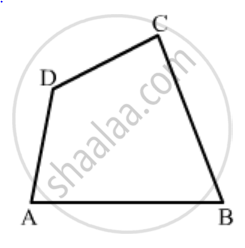
How many pairs of adjacent angles are there?
A quadrilateral has all its four angles of the same measure. What is the measure of each?
Complete the following statement by means of one of those given in brackets against each:
If opposite angles of a quadrilateral are equal, then it is necessarily a ....................
Three angles of a quadrilateral are equal. If the fourth angle is 69°; find the measure of equal angles.
Use the information given in the following figure to find the value of x.
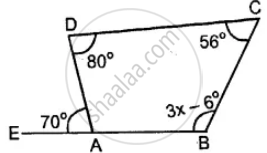
The angles A, B, C and D of a trapezium ABCD are in the ratio 3: 4: 5: 6. Le. ∠A : ∠B : ∠C : ∠D = 3:4: 5 : 6. Find all the angles of the trapezium. Also, name the two sides of this trapezium which are parallel to each other. Give reason for your answer.
In an isosceles trapezium one pair of opposite sides are _____ to each Other and the other pair of opposite sides are _____ to each other.
Write two conditions that will make the adjoining figure a square.

Find the angles of a pentagon which are in the ratio 4: 4: 6: 7: 6.
If one angle of a cyclic quadrilateral is 75°, then the opposite angle is
What is the maximum number of obtuse angles that a quadrilateral can have?
In quadrilateral HOPE, the pairs of opposite sides are ______.
The number of obtuse angles in the following figure is ______.

What conclusion can be drawn from part of given figure, if DB is the bisector of ∠ADC?

Draw a rough sketch of a quadrilateral PQRS. Draw its diagonals. Name them. Is the meeting point of the diagonals in the interior or exterior of the quadrilateral?
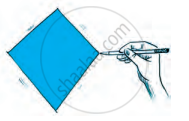
How many points are required to form a quadrilateral?
