Advertisements
Advertisements
प्रश्न
PQRSTU is a regular hexagon. Determine each angle of ΔPQT.
Advertisements
उत्तर
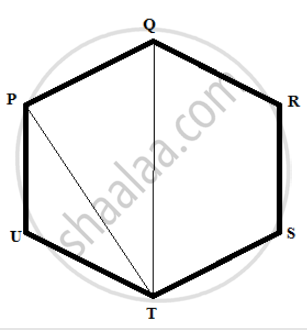
\[\text{ A regular hexagon is made up of 6 equilateral triangles } . \]
\[So, ∠PQT = 60° \text{ and } ∠QTP = 30° \]
\[\text{ Since the sum of the angles of ∆ PQT is } 180° , \text{ we have } : \]
\[ ∠P + ∠Q + ∠T = 180\]
\[ \Rightarrow ∠P + 60° + 30°= 180° \]
\[ \Rightarrow ∠P = 180° - 90° \]
\[ \Rightarrow ∠QPT = 90° \]
\[ \therefore \text{ The angles of the triangle are 90° , 60° and } 30° .\]
संबंधित प्रश्न
In a quadrilateral, define of the following Diagonals .
In a quadrilateral, define of the following Exterior .
A quadrilateral has three acute angles each measures 80°. What is the measure of the fourth angle?
The sides of a quadrilateral are produced in order. What is the sum of the four exterior angles?
In a quadrilateral ABCD, the angles A, B, C and D are in the ratio 1 : 2 : 4 : 5. Find the measure of each angle of the quadrilateral.
ABCD is a trapezium in which AB || DC. M and N are the mid-points of AD and the respectively. If AB = 12 cm, MN = 14 cm, then CD =
In an isosceles trapezium one pair of opposite sides are _____ to each Other and the other pair of opposite sides are _____ to each other.
Find the angles of a pentagon which are in the ratio 4: 4: 6: 7: 6.
If the sum of two angles is equal to an obtuse angle, then which of the following is not possible?
Using the information given, name the right angles in part of figure:
AC ⊥ BD

