Advertisements
Advertisements
प्रश्न
PQRSTU is a regular hexagon. Determine each angle of ΔPQT.
Advertisements
उत्तर
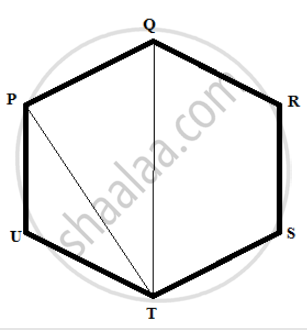
\[\text{ A regular hexagon is made up of 6 equilateral triangles } . \]
\[So, ∠PQT = 60° \text{ and } ∠QTP = 30° \]
\[\text{ Since the sum of the angles of ∆ PQT is } 180° , \text{ we have } : \]
\[ ∠P + ∠Q + ∠T = 180\]
\[ \Rightarrow ∠P + 60° + 30°= 180° \]
\[ \Rightarrow ∠P = 180° - 90° \]
\[ \Rightarrow ∠QPT = 90° \]
\[ \therefore \text{ The angles of the triangle are 90° , 60° and } 30° .\]
संबंधित प्रश्न
Define the following term Quadrilateral .
In a quadrilateral, define of the following Adjacent sides .
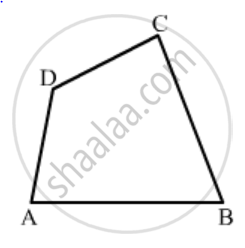
In Fig. 16.19, ABCD is a quadrilateral.
Name a pair of adjacent angles.
Write, giving reason, the name of the figure drawn alongside. Under what condition will this figure be a square.
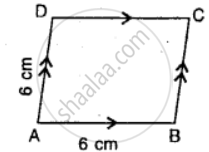
Observe the figure below and find out their name.

ABCDE is a pentagon in which AB is parallel to DC and ∠A : ∠E : ∠D = 1 : 2 : 3. Find angle A.
If angles A, B, C and D of the quadrilateral ABCD, taken in order, are in the ratio 3 : 7 : 6 : 4, then ABCD is a ______.
A quadrilateral can have all four angles as obtuse.
What conclusion can be drawn from part of given figure, if DC is the bisector of ∠ADB, CA ⊥ DA and CB ⊥ DB?

Can we have two obtuse angles whose sum is a reflex angle? Why or why not?
