Advertisements
Advertisements
Question
PQRSTU is a regular hexagon. Determine each angle of ΔPQT.
Advertisements
Solution
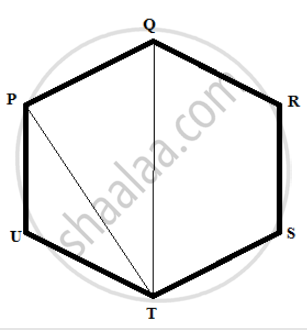
\[\text{ A regular hexagon is made up of 6 equilateral triangles } . \]
\[So, ∠PQT = 60° \text{ and } ∠QTP = 30° \]
\[\text{ Since the sum of the angles of ∆ PQT is } 180° , \text{ we have } : \]
\[ ∠P + ∠Q + ∠T = 180\]
\[ \Rightarrow ∠P + 60° + 30°= 180° \]
\[ \Rightarrow ∠P = 180° - 90° \]
\[ \Rightarrow ∠QPT = 90° \]
\[ \therefore \text{ The angles of the triangle are 90° , 60° and } 30° .\]
RELATED QUESTIONS
Complete of the following, so as to make a true statement:
The number of pairs of adjacent angles of a quadrilateral is .......
In Fig. 16.19, ABCD is a quadrilateral.
Name a pair of opposite angles.

In Fig. 16.19, ABCD is a quadrilateral.
How many pairs of adjacent angles are there?

The four angles of a quadrilateral are as 3 : 5 : 7 : 9. Find the angles.
ABCDE is a regular pentagon. The bisector of angle A of the pentagon meets the side CD in point M. Show that ∠AMC = 90°.
In a parallelogram ABCD, its diagonals AC and BD intersect each other at point O.

If AC = 12 cm and BD = 9 cm ; find; lengths of OA and OD.
Observe the figure below and find out their name.

Number of angles less than 180° in the following figure is ______ and their names are ______.

The number of straight angles in the following figure is ______.

Draw a rough sketch of a quadrilateral KLMN. State two pairs of opposite sides.
