Advertisements
Advertisements
Question
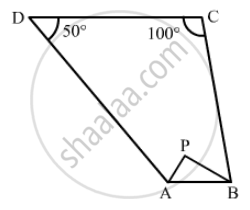
In Fig. 16.21, the bisectors of ∠A and ∠B meet at a point P. If ∠C = 100° and ∠D = 50°, find the measure of ∠APB.
Advertisements
Solution
\[∠A + ∠B + ∠C +∠D = 360° \]
\[ \Rightarrow ∠A +∠B + 100°+ 50° = 360° \]
\[ \Rightarrow ∠A + ∠B = 210° . . . (i)\]
\[\text{ In } \bigtriangleup APB, \text{ we have } : \]
\[\frac{1}{2}∠A + \frac{1}{2}∠B + ∠APB = 180° \]
\[ \Rightarrow ∠APB = 180° - \frac{1}{2}\left( ∠A + ∠B \right)\]
\[\text{ From (i), we get: } \]
\[ \Rightarrow ∠APB = 180° - \left( \frac{1}{2} \times 210° \right) \]
\[ \therefore ∠APB = 75° \]
RELATED QUESTIONS
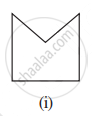
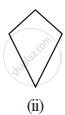
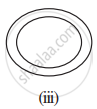
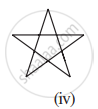
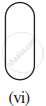
Given here are some figures:
 |
 |
 |
 |
 |
 |
 |
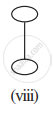 |
Classify each of them on the basis of the following:
- Simple curve
- Simple closed curve
- Polygon
- Convex polygon
- Concave polygon
In a quadrilateral, define of the following Adjacent angles .
Complete of the following, so as to make a true statement:
The sum of the angles of a quiadrilateral is .... right angles.
A quadrilateral has three acute angles each measures 80°. What is the measure of the fourth angle?
If the sum of the two angles of a quadrilateral is 180°. What is the sum of the remaining two angles?
In quadrilateral WXYZ, the pairs of opposite angles are ______.
The number of obtuse angles in the following figure is ______.

Using the information given, name the right angles in part of figure:
RT ⊥ ST

Using the information given, name the right angles in part of figure:
AC ⊥ BD

Investigate :
Use strips and fasteners to make a triangle and a quadrilateral.
Try to push inward at any one vertex of the triangle. Do the same to the quadrilateral. Is the triangle distorted? Is the quadrilateral distorted? Is the triangle rigid?
Why is it that structures like electric towers make use of triangular shapes and not quadrilaterals?
