Advertisements
Advertisements
Question
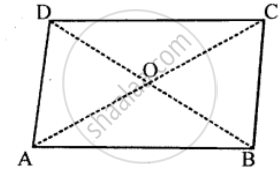
In Fig. 16.19, ABCD is a quadrilateral.
Name a pair of adjacent angles.

Advertisements
Solution
\[ \text{ (∠A, ∠B) or (∠B, ∠C) or (∠C, ∠D) or (∠D, ∠A) } \]
RELATED QUESTIONS
In a quadrilateral, define of the following Angles .
Which of the following quadrilateral is not a rhombus?
In parallelogram ABCD, its diagonals intersect at point O. If OA = 6 cm and OB = 7.5 cm, find the length of AC and BD.
Observe the figure below and find out their name.

Observe the figure below and find out their name.

In quadrilateral ROPE, the pairs of adjacent angles are ______.
If a bicycle wheel has 48 spokes, then the angle between a pair of two consecutive spokes is ______.
Can we have two obtuse angles whose sum is a complete angle? Why or why not?
Draw a rough sketch of a quadrilateral PQRS. Draw its diagonals. Name them. Is the meeting point of the diagonals in the interior or exterior of the quadrilateral?

Draw a rough sketch of a quadrilateral KLMN. State two pairs of opposite sides.
