Advertisements
Advertisements
प्रश्न
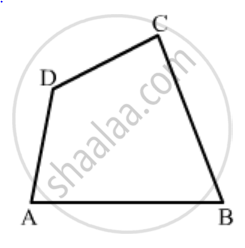
In Fig. 16.19, ABCD is a quadrilateral.
How many pairs of adjacent angles are there?
Advertisements
उत्तर
Four
संबंधित प्रश्न
In a quadrilateral, define of the following Diagonals .
In a quadrilateral, define of the following Adjacent sides .
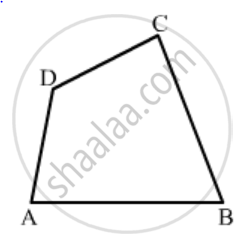
In Fig. 16.19, ABCD is a quadrilateral.
Name a pair of opposite angles.
Complete the following statement by means of one of those given in brackets against each:
If both pairs of opposite sides of a quadrilateral are equal, then it is necessarily a ...............
Mark the correct alternative in each of the following:
The opposite sides of a quadrilateral have
In parallelogram ABCD, ∠A = 90°
(i) What is the measure of angle B.
(ii) Write the special name of the parallelogram.
If angles A, B, C and D of the quadrilateral ABCD, taken in order, are in the ratio 3 : 7 : 6 : 4, then ABCD is a ______.
In quadrilateral ROPE, the pairs of adjacent angles are ______.
The number of common points in the two angles marked in the following figure is ______.

Using the information given, name the right angles in part of figure:
RT ⊥ ST

