Advertisements
Advertisements
प्रश्न
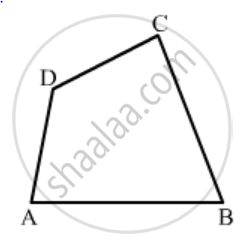
In a quadrilateral, define of the following Opposite angles .
Advertisements
उत्तर
\[ \text{ The two angles of a quadrilateral which are not adjacent are called opposite angles } . \]
संबंधित प्रश्न
How many diagonals does following have?
A regular hexagon
What is the sum of the measures of the angels of a convex quadrilateral? Will this property hold if the quadrilateral is not convex? (Make a non-convex quadrilateral and try!)
In Fig. 16.19, ABCD is a quadrilateral.
How many pairs of opposite angles are there?
In ΔABC, E is the mid-point of median AD such that BE produced meets AC at F. IF AC = 10.5 cm, then AF =
In a trapezium ABCD, side AB is parallel to side DC. If ∠A = 78° and ∠C = 120. find angles B and D.
Observe the figure below and find out their name.
One angle of a pentagon is 160° and the rest are all equal angles. Find the measure of the equal angles.
Calculate the measure of each angle of a nonagon.
Measures of the two angles between hour and minute hands of a clock at 9 O’ clock are ______.
In the following figure, What is BD – BE?

