Advertisements
Advertisements
प्रश्न
Two angles of a quadrilateral are 68° and 76°. If the other two angles are in the ratio 5 : 7; find the measure of each of them.
Advertisements
उत्तर
Two angles are 68° and 76°
Let other two angles be 5x and 7x
68° + 76°+ 5x + 7x = 360°
12x + 144° = 360°
12x = 360° – 144°
12x = 216°
x = 18°
angles are 5x and 7x
i.e. 5 x 18° and 7 x 18° i.e. 90° and 126°
संबंधित प्रश्न
Define the following term Convex Quadrilateral .
In a quadrilateral, define of the following Diagonals .
In a quadrilateral, define of the following Interior .
Complete of the following, so as to make a true statement:
The number of pairs of adjacent angles of a quadrilateral is .......
Complete of the following, so as to make a true statement:
The sum of the angles of a quadrilateral is ......
Complete of the following, so as to make a true statement:
The sum of the angles of a quiadrilateral is .... right angles.
Complete the following statement by means of one of those given in brackets against each:
If in a quadrilateral only one pair of opposite sides are parallel, the quadrilateral is ................
Complete the following statement by means of one of those given in brackets against each:
If opposite angles of a quadrilateral are equal, then it is necessarily a ....................
In ΔABC, E is the mid-point of median AD such that BE produced meets AC at F. IF AC = 10.5 cm, then AF =
In quadrilateral ABCD, side AB is parallel to side DC. If ∠A : ∠D = 1 : 2 and ∠C : ∠B = 4 : 5
(i) Calculate each angle of the quadrilateral.
(ii) Assign a special name to quadrilateral ABCD
Angle A of an isosceles trapezium ABCD is 115°; find the angles B, C and D.
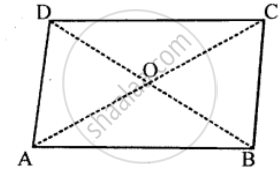
In parallelogram ABCD, its diagonals intersect at point O. If OA = 6 cm and OB = 7.5 cm, find the length of AC and BD.
Three angles of a quadrilateral are 75º, 90º and 75º. The fourth angle is ______.
If APB and CQD are two parallel lines, then the bisectors of the angles APQ, BPQ, CQP and PQD form ______.
What is the maximum number of obtuse angles that a quadrilateral can have?
In the following figure, ∠XYZ cannot be written as ______.

Number of angles less than 180° in the following figure is ______ and their names are ______.

Using the information given, name the right angles in part of figure:
RT ⊥ ST

Draw a rough sketch of a quadrilateral KLMN. State two pairs of adjacent sides.
