Advertisements
Advertisements
प्रश्न
Two angles of a quadrilateral are 68° and 76°. If the other two angles are in the ratio 5 : 7; find the measure of each of them.
Advertisements
उत्तर
Two angles are 68° and 76°
Let other two angles be 5x and 7x
68° + 76°+ 5x + 7x = 360°
12x + 144° = 360°
12x = 360° – 144°
12x = 216°
x = 18°
angles are 5x and 7x
i.e. 5 x 18° and 7 x 18° i.e. 90° and 126°
संबंधित प्रश्न
Complete of the following, so as to make a true statement:
The measure of each angle of a convex quadrilateral is ..... 180°.
Complete of the following, so as to make a true statement:
A point is in the interior of a convex quadrilateral, if it is in the ..... of its two opposite angles.
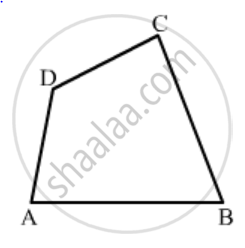
In Fig. 16.19, ABCD is a quadrilateral.
Name a pair of adjacent angles.
Complete the following statement by means of one of those given in brackets against each:
A line drawn from the mid-point of one side of a triangle .............. another side intersects the third side at its mid-point.
ABCD is a trapezium in which AB || DC. M and N are the mid-points of AD and the respectively. If AB = 12 cm, MN = 14 cm, then CD =
Given : In quadrilateral ABCD ; ∠C = 64°, ∠D = ∠C – 8° ; ∠A = 5(a+2)° and ∠B = 2(2a+7)°.
Calculate ∠A.
Two diagonals of an isosceles trapezium are x cm and (3x – 8) cm. Find the value of x.
Two adjacent angles of a parallelogram are 70° and 110° respectively. Find the other two angles of it.
In a parallelogram ABCD, its diagonals AC and BD intersect each other at point O.

If AC = 12 cm and BD = 9 cm ; find; lengths of OA and OD.
Observe the figure below and find out their name.

If angles A, B, C and D of the quadrilateral ABCD, taken in order, are in the ratio 3 : 7 : 6 : 4, then ABCD is a ______.
If APB and CQD are two parallel lines, then the bisectors of the angles APQ, BPQ, CQP and PQD form ______.
What is the maximum number of obtuse angles that a quadrilateral can have?
Measures of the two angles between hour and minute hands of a clock at 9 O’ clock are ______.
In the following figure, ∠XYZ cannot be written as ______.

The number of obtuse angles in the following figure is ______.

If the sum of two angles is greater than 180°, then which of the following is not possible for the two angles?
Number of angles less than 180° in the following figure is ______ and their names are ______.

Can we have two obtuse angles whose sum is a reflex angle? Why or why not?
In quadrilateral PQRS, which pair represents adjacent sides?
