Advertisements
Advertisements
प्रश्न
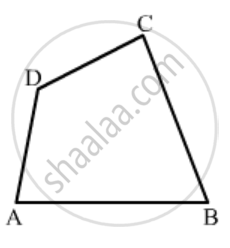
In Fig. 16.19, ABCD is a quadrilateral.
Name a pair of adjacent sides.
Advertisements
उत्तर
\[ \text{ (AB, BC) or (BC, CD) or (CD, DA) or (AD, AB) } \]
संबंधित प्रश्न
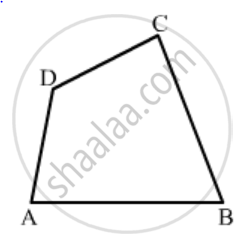
In Fig. 16.19, ABCD is a quadrilateral.
Name a pair of opposite angles.
Three angles of a quadrilateral are equal. Fourth angle is of measure 150°. What is the measure of equal angles.
The sum of the interior angles of a polygon is three times the sum of its exterior angles. Determine the number of sided of the polygon.
In parallelogram ABCD, ∠A = 90°
(i) What is the measure of angle B.
(ii) Write the special name of the parallelogram.
The angles of a pentagon are x°, (x - 10)°, (x + 20)°, (2x - 44)° and (2x - 70)°. Find the angles.
In a quadrilateral ABCD, ∠A = 72° and ∠C is the supplementary of ∠A. The other two angles are 2x – 10 and x + 4. Find the value of x and the measure of all the angles
Construct a quadrilateral NEWS in which NE = 7 cm, EW = 6 cm, ∠N = 60°, ∠E = 110° and ∠S = 85°.
The number of common points in the two angles marked in the following figure is ______.

Using the information given, name the right angles in part of figure:
AE ⊥ CE

How many points are required to form a quadrilateral?
