Advertisements
Advertisements
प्रश्न
Two angles of a quadrilateral are 89° and 113°. If the other two angles are equal; find the equal angles.
Advertisements
उत्तर
Let the other angle = x°
According to given,
89° + 113° + x° + x° = 360°
2x° = 360° – 202°
2x° = 158°
x° = `158/2`
other two angles = 79° each
संबंधित प्रश्न
In a quadrilateral, define of the following Opposite angles .
In a quadrilateral, define of the following Interior .
Complete of the following, so as to make a true statement:
A quadrilateral has ....... sides.
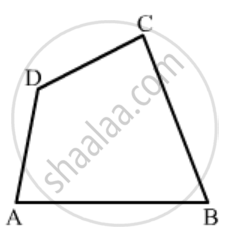
In Fig. 16.19, ABCD is a quadrilateral.
How many pairs of adjacent sides are there?
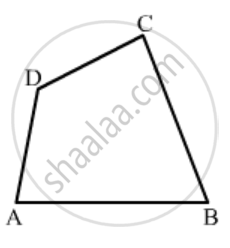
In Fig. 16.19, ABCD is a quadrilateral.
How many pairs of opposite sides are there?
The angles of a quadrilateral are 110°, 72°, 55° and x°. Find the value of x.
Two angles of a quadrilateral are of measure 65° and the other two angles are equal. What is the measure of each of these two angles?
The consecutive sides of a quadrilateral have
In an isosceles trapezium one pair of opposite sides are _____ to each Other and the other pair of opposite sides are _____ to each other.
ΔPQR and ΔSQR are on the same base QR with P and S on opposite sides of line QR, such that area of ΔPQR is equal to the area of ΔSQR. Show that QR bisects PS.
In the following figure, ∠XYZ cannot be written as ______.

In the following figure,

∠COA is a/an ______ angle
The number of common points in the two angles marked in the following figure is ______.

In the following figure, What is BD – DE?

Using the information given, name the right angles in part of figure:
AC ⊥ BD

What conclusion can be drawn from part of given figure, if DB is the bisector of ∠ADC?

How many points are required to form a quadrilateral?
Which of the following is a key requirement for correctly naming a □ABCD?
