Advertisements
Advertisements
प्रश्न
Two angles of a quadrilateral are 89° and 113°. If the other two angles are equal; find the equal angles.
Advertisements
उत्तर
Let the other angle = x°
According to given,
89° + 113° + x° + x° = 360°
2x° = 360° – 202°
2x° = 158°
x° = `158/2`
other two angles = 79° each
संबंधित प्रश्न
How many diagonals does following have?
A regular hexagon
How many diagonals does following have?
A triangle
Complete of the following, so as to make a true statement:
A quadrilateral has ....... sides.
Complete of the following, so as to make a true statement:
A quadrilateral has ...... angles.
Complete of the following, so as to make a true statement:
A quadrilateral has .... diagonals.
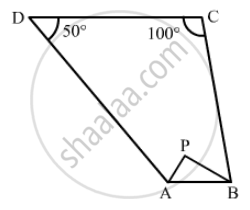
In Fig. 16.21, the bisectors of ∠A and ∠B meet at a point P. If ∠C = 100° and ∠D = 50°, find the measure of ∠APB.
In a quadrilateral ABCD, CO and DO are the bisectors of ∠C and ∠D respectively. Prove that \[∠COD = \frac{1}{2}(∠A + ∠B) .\]
The measure of angles of a hexagon are x°, (x − 5)°, (x − 5)°, (2x − 5)°, (2x − 5)°, (2x + 20)°. Find the value of x.
Complete the following statement by means of one of those given in brackets against each:
A line drawn from the mid-point of one side of a triangle .............. another side intersects the third side at its mid-point.
Complete the following statement by means of one of those given in brackets against each:
If both pairs of opposite sides of a quadrilateral are equal, then it is necessarily a ...............
If ABCD is a rectangle with ∠BAC = 32°, find the measure of ∠DBC.
ABCDE is a regular pentagon. The bisector of angle A of the pentagon meets the side CD in point M. Show that ∠AMC = 90°.
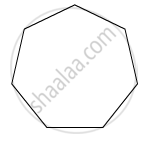
Observe the figure below and find out their name.
The angles of a hexagon are (2x + 5)°, (3x - 5)°, (x + 40)°, (2x + 20)°, (2x + 25)° and (2x + 35)°. Find the value of x.
A diagonal of a rectangle is inclined to one side of the rectangle at 25º. The acute angle between the diagonals is ______.
In quadrilateral HOPE, the pairs of opposite sides are ______.
Measures of the two angles between hour and minute hands of a clock at 9 O’ clock are ______.
If the sum of two angles is greater than 180°, then which of the following is not possible for the two angles?
Can we have two obtuse angles whose sum is a reflex angle? Why or why not?
Draw a rough sketch of a quadrilateral PQRS. Draw its diagonals. Name them. Is the meeting point of the diagonals in the interior or exterior of the quadrilateral?