Advertisements
Advertisements
Question
In quadrilateral ABCD, side AB is parallel to side DC. If ∠A : ∠D = 1 : 2 and ∠C : ∠B = 4 : 5
(i) Calculate each angle of the quadrilateral.
(ii) Assign a special name to quadrilateral ABCD
Advertisements
Solution
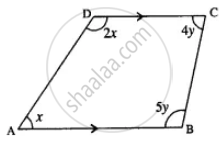
(i) ∵ ∠A : ∠D = 1 : 2
Let ∠A = x and ∠D = 2x
∵ ∠C : ∠B = 4 : 5
Let ∠C = 4y and ∠B = 5y
∵ AB || DC
∴ ∠A + ∠D = 180°
x + 2x = 180°
3x = 180°
x = 60°
∴ A = 60°
∠D = 2x = 2 × 60 = 120°
Again ∠B + ∠C = 180°
5y + 4y = 180°
9y = 180°
y = 20°
∴ ∠B = 5y = 5 x 20 = 100°
∠C = 4y = 4 x 20 = 80°
Hence ∠A = 60°; ∠B = 100°; ∠C = 80°
and ∠D = 120°
(ii) `square` ABCD is a trapezium.
RELATED QUESTIONS
Define the following term Quadrilateral .
In Fig. 16.19, ABCD is a quadrilateral.
How many pairs of adjacent sides are there?
The three angles of a quadrilateral are respectively equal to 110°, 50° and 40°. Find its fourth angle.
In a convex hexagon, prove that the sum of all interior angle is equal to twice the sum of its exterior angles formed by producing the sides in the same order.
Complete the following statement by means of one of those given in brackets against each:
A line drawn from the mid-point of one side of a triangle .............. another side intersects the third side at its mid-point.
Which of the following quadrilateral is not a rhombus?
Given : In quadrilateral ABCD ; ∠C = 64°, ∠D = ∠C – 8° ; ∠A = 5(a+2)° and ∠B = 2(2a+7)°.
Calculate ∠A.
One diagonal of a rectangle is 18 cm. What is the length of its other diagonal?
The angles of a hexagon are (2x + 5)°, (3x - 5)°, (x + 40)°, (2x + 20)°, (2x + 25)° and (2x + 35)°. Find the value of x.
One angle of a hexagon is 140° and the remaining angles are in the ratio 4 : 3 : 4 : 5 : 4. Calculate the measures of the smallest and the largest angles.
ABCDE is a pentagon in which AB is parallel to DC and ∠A : ∠E : ∠D = 1 : 2 : 3. Find angle A.
In a quadrilateral ABCD, ∠A = 72° and ∠C is the supplementary of ∠A. The other two angles are 2x – 10 and x + 4. Find the value of x and the measure of all the angles
If the sum of two angles is equal to an obtuse angle, then which of the following is not possible?
In the following figure,

∠AOE is a/an ______ angle
Number of angles less than 180° in the following figure is ______ and their names are ______.

The common part between the two angles BAC and DAB in the following figure is ______.

In the following figure, name any two angles that appear to be obtuse angles.

Using the information given, name the right angles in part of figure:
BA ⊥ BD

Can we have two obtuse angles whose sum is a reflex angle? Why or why not?
Which of the following is a key requirement for correctly naming a □ABCD?
