Advertisements
Advertisements
प्रश्न
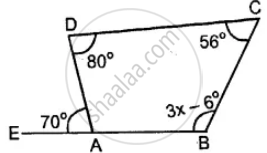
Use the information given in the following figure to find the value of x.
Advertisements
उत्तर
Take A, B, C, D as the vertices of Quadrilateral and BA is produced to E (say).
Since ∠EAD = 70°
∴ ∠DAB = 180° – 70°= 110° [EAB is a straight line and AD stands on it ∠EAD+ ∠DAB = 180°]
∴ 110° + 80° + 56° + 3x – 6° = 360°
[∵ sum of interior angles of a quadrilateral = 360°]
∴ 3x = 360° – 110° – 80° – 56° + 6°
3x = 360° – 240° = 120°
∴ x = 40°
संबंधित प्रश्न
Complete of the following, so as to make a true statement:
The number of pairs of opposite angles of a quadrilateral is .......
Complete of the following, so as to make a true statement:
The sum of the angles of a quadrilateral is ......
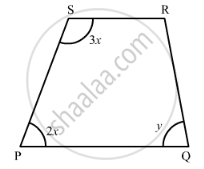
In the given figure, PQRS is an isosceles trapezium. Find x and y.
If the bisectors of two adjacent angles A and B of a quadrilateral ABCD intersect at a point O such that ∠C + ∠D = k ∠AOB, then find the value of k.
In ΔABC, E is the mid-point of median AD such that BE produced meets AC at F. IF AC = 10.5 cm, then AF =
Two angles of a quadrilateral are 68° and 76°. If the other two angles are in the ratio 5 : 7; find the measure of each of them.
One diagonal of a rectangle is 18 cm. What is the length of its other diagonal?
Calculate the measure of each angle of a nonagon.
If bisectors of ∠A and ∠B of a quadrilateral ABCD intersect each other at P, of ∠B and ∠C at Q, of ∠C and ∠D at R and of ∠D and ∠A at S, then PQRS is a ______.
D and E are the mid-points of the sides AB and AC respectively of ∆ABC. DE is produced to F. To prove that CF is equal and parallel to DA, we need an additional information which is ______.
In quadrilateral ROPE, the pairs of adjacent angles are ______.
A quadrilateral can have all four angles as obtuse.
Both the pairs of opposite angles of a quadrilateral are equal and supplementary. Find the measure of each angle.
In the following figure, ∠XYZ cannot be written as ______.

The number of obtuse angles in the following figure is ______.

In the following figure, What is AE + EC?

What conclusion can be drawn from part of given figure, if DB is the bisector of ∠ADC?

Draw a rough sketch of a quadrilateral KLMN. State two pairs of opposite angles.
How many points are required to form a quadrilateral?
Which of the following represents the vertices of quadrilateral ABCD?
