Advertisements
Advertisements
प्रश्न
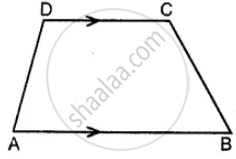
The following figure shows a quadrilateral in which sides AB and DC are parallel. If ∠A : ∠D = 4 : 5, ∠B = (3x – 15)° and ∠C = (4x + 20)°, find each angle of the quadrilateral ABCD.
Advertisements
उत्तर
Let ∠A = 4x
∠D = 5x
Since ∠A + ∠D = 180° [AB||DC]
4x + 5x = 180°
⇒ 9x = 180°
⇒ x = 20°
∠A = 4 (20) = 80°,
∠D = 5 (20) = 100°
Again ∠B + ∠C = 180° [ AB||DC]
3x – 15° + 4x + 20° = 180°
7x = 180° – 5°
⇒ 7x = 175°
⇒ x = 25°
∠B = 75° – 15° = 60°
and ∠C = 4 (25) + 20 = 100°+ 20°= 120°
संबंधित प्रश्न
Complete of the following, so as to make a true statement:
A quadrilateral has ....... sides.
Complete of the following, so as to make a true statement:
The measure of each angle of a convex quadrilateral is ..... 180°.
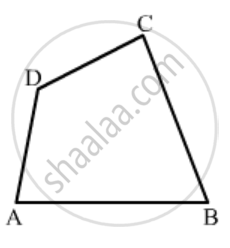
In Fig. 16.19, ABCD is a quadrilateral.
Name a pair of adjacent sides.
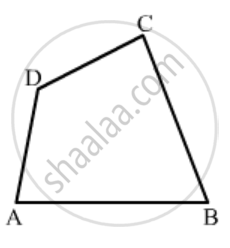
In Fig. 16.19, ABCD is a quadrilateral.
Name a pair of opposite sides.
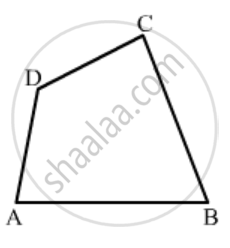
In Fig. 16.19, ABCD is a quadrilateral.
How many pairs of opposite sides are there?
A quadrilateral has three acute angles each measures 80°. What is the measure of the fourth angle?
The measure of angles of a hexagon are x°, (x − 5)°, (x − 5)°, (2x − 5)°, (2x − 5)°, (2x + 20)°. Find the value of x.
Complete the following statement by means of one of those given in brackets against each:
If in a quadrilateral only one pair of opposite sides are parallel, the quadrilateral is ................
Which of the following quadrilateral is not a rhombus?
Two angles of a quadrilateral are 89° and 113°. If the other two angles are equal; find the equal angles.
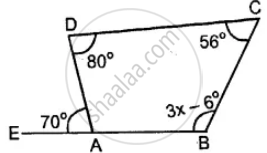
From the following figure find;
- x
- ∠ABC
- ∠ACD
Use the information given in the following figure to find the value of x.
ABCDE is a regular pentagon. The bisector of angle A of the pentagon meets the side CD in point M. Show that ∠AMC = 90°.
In a parallelogram ABCD, its diagonals AC and BD intersect each other at point O.

If AC = 12 cm and BD = 9 cm ; find; lengths of OA and OD.
One diagonal of a rectangle is 18 cm. What is the length of its other diagonal?
Write two conditions that will make the adjoining figure a square.

One angle of a hexagon is 140° and the remaining angles are in the ratio 4 : 3 : 4 : 5 : 4. Calculate the measures of the smallest and the largest angles.
ABCD is a quadrilateral in which AB || DC and AD = BC. Prove that ∠A = ∠B and ∠C = ∠D.
Can we have two obtuse angles whose sum is a reflex angle? Why or why not?
In quadrilateral PQRS, which pair represents adjacent sides?
