Advertisements
Advertisements
Question
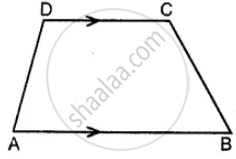
The following figure shows a quadrilateral in which sides AB and DC are parallel. If ∠A : ∠D = 4 : 5, ∠B = (3x – 15)° and ∠C = (4x + 20)°, find each angle of the quadrilateral ABCD.
Advertisements
Solution
Let ∠A = 4x
∠D = 5x
Since ∠A + ∠D = 180° [AB||DC]
4x + 5x = 180°
⇒ 9x = 180°
⇒ x = 20°
∠A = 4 (20) = 80°,
∠D = 5 (20) = 100°
Again ∠B + ∠C = 180° [ AB||DC]
3x – 15° + 4x + 20° = 180°
7x = 180° – 5°
⇒ 7x = 175°
⇒ x = 25°
∠B = 75° – 15° = 60°
and ∠C = 4 (25) + 20 = 100°+ 20°= 120°
RELATED QUESTIONS
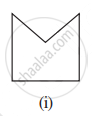
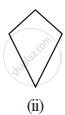
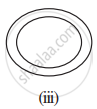
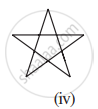
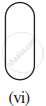
Given here are some figures:
 |
 |
 |
 |
 |
 |
 |
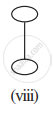 |
Classify each of them on the basis of the following:
- Simple curve
- Simple closed curve
- Polygon
- Convex polygon
- Concave polygon
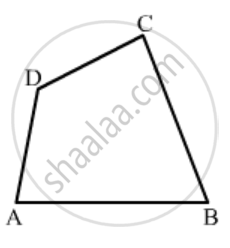
In Fig. 16.19, ABCD is a quadrilateral.
How many pairs of opposite sides are there?
In a quadrilateral ABCD, the angles A, B, C and D are in the ratio 1 : 2 : 4 : 5. Find the measure of each angle of the quadrilateral.
Complete the following statement by means of one of those given in brackets against each:
A line drawn from the mid-point of one side of a triangle .............. another side intersects the third side at its mid-point.
Which of the following quadrilateral is not a rhombus?
Given : In quadrilateral ABCD ; ∠C = 64°, ∠D = ∠C – 8° ; ∠A = 5(a+2)° and ∠B = 2(2a+7)°.
Calculate ∠A.
Two adjacent angles of a parallelogram are 70° and 110° respectively. Find the other two angles of it.
ABCDE is a pentagon in which AB is parallel to DC and ∠A : ∠E : ∠D = 1 : 2 : 3. Find angle A.
If angles A, B, C and D of the quadrilateral ABCD, taken in order, are in the ratio 3 : 7 : 6 : 4, then ABCD is a ______.
What is the maximum number of obtuse angles that a quadrilateral can have?
Both the pairs of opposite angles of a quadrilateral are equal and supplementary. Find the measure of each angle.
Measures of the two angles between hour and minute hands of a clock at 9 O’ clock are ______.
In the following figure, if point A is shifted to point B along the ray PX such that PB = 2PA, then the measure of ∠BPY is ______.

A pair of opposite sides of a trapezium are ______.
The number of right angles in a straight angle is ______ and that in a complete angle is ______.
Using the information given, name the right angles in part of figure:
RT ⊥ ST

Using the information given, name the right angles in part of figure:
AC ⊥ CD

Can we have two obtuse angles whose sum is a complete angle? Why or why not?
Draw a rough sketch of a quadrilateral KLMN. State two pairs of adjacent angles.
How many points are required to form a quadrilateral?
