Advertisements
Advertisements
Question
In an isosceles trapezium one pair of opposite sides are _____ to each Other and the other pair of opposite sides are _____ to each other.
Advertisements
Solution
In an isosceles trapezium one pair of opposite sides are parallel to each other and the other pair of opposite sides are equal to each other.
APPEARS IN
RELATED QUESTIONS
In a quadrilateral, define of the following Opposite angles .
PQRSTU is a regular hexagon. Determine each angle of ΔPQT.
Complete the following statement by means of one of those given in brackets against each:
If one pair of opposite sides are equal and parallel, then the figure is ........................
If ABCD is a rectangle with ∠BAC = 32°, find the measure of ∠DBC.
Two angles of a quadrilateral are 89° and 113°. If the other two angles are equal; find the equal angles.
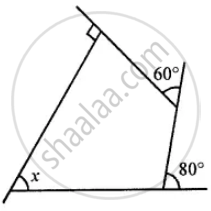
Use the following figure to find the value of x
If three angles of a quadrilateral are 90° each, show that the given quadrilateral is a rectangle.
Observe the figure below and find out their name.

A pair of opposite sides of a trapezium are ______.
An angle is said to be trisected, if it is divided into three equal parts. If in the following figure, ∠BAC = ∠CAD = ∠DAE, how many trisectors are there for ∠BAE?

