C. B. Gupta solutions for Business Studies [English] Class 12 ISC chapter 14 - Business Communication [Latest edition]
Chapters
2: Job Analysis and Manpower Planning
3: Staff Recruitment
4: Staff Selection
5: Staff Training
6: Staff Morale
7: Staff Motivation
8: Staff Remuneration
9: Staff Leadership
10: Staff Appraisal
11: Staff Promotion and Transfer
12: Staff Separation
13: Emerging Trends in Human Resources
▶ 14: Business Communication
15: Business Correspondence
16: Reports and Report Writing
17: Various Business Entities
18: Sources of Business Finance
19: Globalisation
20: E-Business
21: Outsourcing
22: Business Regulators and Intermediaries
Advertisements
Advertisements
Solutions for Chapter 14: Business Communication
Below listed, you can find solutions for Chapter 14 of CISCE C. B. Gupta for Business Studies [English] Class 12 ISC.
Advertisements
C. B. Gupta solutions for Business Studies [English] Class 12 ISC 14 Business Communication EXERCISES [Pages 255 - 264]
Objective Type Questions MCQ's (Select the best Alternative)
Which of the following is not a type of formal communication?
Upward Communication
‘Grapevine’
Diagonal Communication
All of these
In effective communication, language should not be used:
express
impressive
ambiguous
courtesy
Grapevine communication is ______.
informal
formal
written
none of these
Status comes under the following type of barriers.
Semantic barrier
Organisational barrier
Non-semantic barrier
Socio-Psychological barrier
The process of converting the message into communication symbols is known as ______.
Media
Encoding
Feedback
Decoding
Which of the following is not an element of communication process?
Decoding
Observer
Channel
Receiver
If you want to keep a proof of your communication, you should use ______ communication.
informal
formal
verbal
none of these
Which of the following is not an organisational barrier of communication?
Organisational Policy
Rules and Regulations
Complexity in organisational structure
Fear of challenge to authority
In horizontal communication, flow of suggestion is ______.
upward
downward
at parallel
all of these
Barriers in effective communication are ______.
language
distance
individual differences
all of these
With reference to the types of Business Communication, identify the odd one out.
Formal Communication
Internal Communication
Diagonal Communication
Oral Communication
Understanding the forms of diagrams or symbols correctly, is known as ______.
Encoding
Transmission
Decoding
Feedback
Identify a semantic barrier out of the following:
Rules and Regulations
District
Technical Jargons
Complex Organizational Structure
Assertion (A): Verbal communication takes place in real time.
Reason (R): Written communication is synchronous in character as it appears at different level.
Both A and R are true and R is the correct explanation of A
Both A and R are true, but R is not the correct explanation of A
A is true, but R is false
A is false, but R is true
Assertion (A): Nonverbal communication is related to expression of feelings and emotions.
Reason (R): Body language is a kind of verbal communication.
Both A and R are true and R is the correct explanation of A
Both A and R are true, but R is not the correct explanation of A
A is true, but R is false
A is false, but R is true
Identify the type of communication from the following image:
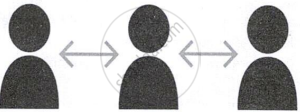
Vertical
Horizontal
Upward
Downward
Match the following:
| Column I | Column II |
|---|---|
| 1. Meetings | (i) Visual |
| 2. Bulletins | (ii) Gestural |
| 3. Nodding head | (iii) Written |
| 4. Graphs | (iv) Oral |
1-(i), 2-(ii), 3-(iii), 4-(iv)
1-(iv), 2-(iii), 3-(ii), 4-(i)
1-(iii), 2-(ii), 3-(i), 4-(iv)
1-(iv), 2-(i), 3-(iii), 4-(iv)
Match the following:
| Column I | Column II |
|---|---|
| 1. Poor Retention | (i) Semantic barriers |
| 2. Faulty translations | (ii) Physical and mechanical barriers |
| 3. Inappropriate medium | (iii) Organizational barriers |
| 4. Distance and time | (iv) Socio-psychological barriers |
1-(i), 2-(ii), 3-(iii), 4-(iv)
1-(iv), 2-(iii), 3-(ii), 4-(i)
1-(iii), 2-(ii), 3-(i), 4-(iv)
1-(iv), 2-(i), 3-(iii), 4-(ii)
Given below are two statements:
Statement I: All messages received by an organization from outside are inward communication.
Statement II: All the messages that go out of an organization are outward communication.
In the light of the above statements, choose the most appropriate answer from the options given below:
Both Statement I and II are correct
Both Statement I and II are incorrect
Statement I is correct but Statement II is incorrect
Statement I is incorrect but Statement II is correct
Given below are two statements:
Statement I: Feedback is the only way of judging the effectiveness of the message.
Statement II: The receiver of the message cannot ask questions in case he does not understand the message.
In the light of the above statements, choose the most appropriate answer from the options given below:
Both Statement I and II are correct
Both Statement I and II are incorrect
Statement I is correct but Statement II is incorrect
Statement I is incorrect but Statement II is correct
Visual Communication : an Image : : Gestural : ______
Letter
Body language
Interview
Ideas
Physical and Mechanical Barriers : Distance and Time : : Semantic Barriers : ______
Noise
Long chain of command
Unclarified assumptions
Status and fear
Read the two statements given below and choose the correct option.
Statement I: In order to ensure effective learning, a teacher must minimise the barriers to communication.
Statement II: Communication is incomplete without feedback.
Statement I is true but Statement II is false.
Statement I is false but Statement II is true.
Both Statement I and Statement II are true, and Statement II is the correct explanation for Statement I.
Both Statement I and Statement II are true. But Statement II is not the correct explanation for Statement I.

Identify the method of communication expressed in the above picture.
Oral Communication
Visual Communication
Written Communication
Gestural Communication
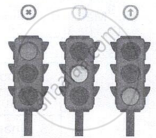
Which method of communication is expressed in the above picture?
Oral Communication
Visual Communication
Written Communication
Gestural Communication
Employees are sometimes reluctant to share their ideas and opinions, in their organisations because they fear being judged. They don't seem to realise that critical review is essential for growth.
Identify the barrier to communication being addressed in the above statement.
Social Barrier
Physical Barrier
Organisational Barrier
Socio-Psychological Barrier
Assertion (A): A video conference is a virtual meeting between people at different geographical locations.
Reason (R): A video conference combines audio and video media.
Both A and R are true, and R is the correct explanation of A.
Both A and R are true, and R is not the correct explanation of A.
A is true, but R is false.
A is false, but R is true.
Assertion (A): Pictorial presentation in visual communication helps in better understanding.
Reason (R): Pictorial presentation can convert simple information into complex visuals, such as charts, graphs, and diagrams.
Both A and R are true, and R is the correct explanation of A.
Both A and R are true, but R is not the correct explanation of A.
A is true, but R is false.
A is false, but R is true.
Statement I: In order to ensure effective learning, a teacher must minimise the barriers to communication.
Statement II: Communication is incomplete without feedback.
Statement I is true but Statement II is false.
Statement I is false but Statement II is true.
Both Statement I and Statement II are true, and Statement II is the correct explanation for Statement I.
Both Statement I and Statement II are true. But Statement II is not the correct explanation for Statement I.
Organisational barriers to communication refer to those obstacles that hinder the flow of communication within an organisation.
Which one of the following scenarios correctly indicates an organisational barrier?
Rohit submits a report to his Manager about a new consignment. The report is ambiguous, poorly worded, and does not present all facts.
Vidya has innovative ideas on product design, but is hesitant to present them to her superior as she fears rejection.
Tarun, an employee at Tarzan Associates, urgently needs to meet the General Manager. However, his immediate superior tells him to follow all the levels of hierarchy and then meet the General Manager.
Some employees at ABC Ltd. could not apply for the position of a Manager within the companу, due to a technical error in the internet server in their department.
Fill in the blanks with suitable words given in brackets
Every member of the organisation should have a ______ channel of communication.
proper
improper
both
Communication should be a ______ traffic.
one way
two way
both
Poor retention, inattention, emotions attitudes and opinions, emotions, etc. are ______ barriers to communication.
Organisational
Socio-Psychological
Semantic
______ is the only way for judging the effectiveness of the message.
Face to face contact is ______ communication.
oral
written
both
______ message can be kept for future reference.
oral
written
both
Way of planned communication should be ______.
right
definite
straight
______ refers to that part of communication process, where the sender puts his/her ideas or facts into words, symbols, pictures or gestures that can be understood by the receiver.
Encoding
Decoding
Feedback
On the basis of ______, communication may be classified as formal and informal.
Communication between department or functional units of the companies is known as ______.
Horizontal
Vertical
______ is the cheapest and fastest means of electronically transmitting written messages which can also be used as legal evidence.
Communication problems otherwise known as ______.
Enquire
Barriers
Encoding
Information about its products is ______ communication.
Internal
External
Audio
Observe the relation between the first two words and then fill in the fourth word.
Verbal communication : Oral communication : : Non verbal communication : ______.
On the basis of ______, Communication may be classified as internal and external.
Observe the relation between the first two words/terms and then fill in the fourth word/term.
Graphs : Visual communication : : Body movements : ______
Welcoming a new employee in an organisation with a firm handshake/‘namaste’ is an example of ______ communication.
True or False:
Non-verbal communication can be independent of verbal communication but verbal communication is always accompanied by non-verbal communication.
True or False:
Communication is a static concept.
True or False:
Informal communication is referred to as Grapevine.
True or False:
Feedback is a form of upward communication.
True or False:
Magazines are oral form of communication.
True or False:
Clarity in messages is one of the ways to overcome miscommunication.
True or False:
A traffic police showing a stop sign to the public is the sender of a message in the process of communication.
State whether the following are True or False:
Informal communication is completely authentic and reliable.
Very Short Answer Type Questions
How does Informal communication supplement the formal communication in many ways?
Answer in one sentence.
What is communication?
What is the importance of communication in management?
Define ‘Formal Communication’.
Why is Informal system of communication generally referred to as the “grapevine communication”?
What is the concept of noise in the communication?
What is the importance of feedback in a communication process?
How does communication act as basis of decision making?
How does communication increase managerial efficiency?
Is it necessary in communication that the sender and receiver of information should be face-to-face with each other?
What represents semantic barriers of communication?
Is it necessary to believe or agree with the message in order to complete the process of communication?
Is communication complete without feedback?
What is meant by 'Decoding' as an element of communication?
Anil and Sunil are working in Astro Ltd as production incharge respectively. One day during lunch time Sunil informed Anil that due to computerisation many people are going to be retrenched. Name which type of communication is this?
Which type of communication is represented in the following picture?
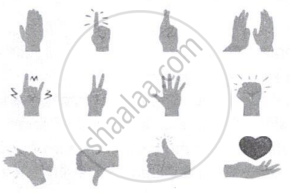
Differentiate between Internal and External communication.
"Formal Communication constitutes the main line of operational communication of the organization." Justify.
How is Email different from Fax?
Discuss in brief various barriers to communication.
The kitchen of a restaurant caught fire leading to multiple explosions of gas cylinders. The restaurant manager immediately advised the diners to go out from safety doors. Some of the diners could not hear the instructions clearly, so ran towards the kitchen.
Name the barrier to communication in the above case.
Comment on any one use of electronic mail that indicates its portability.
Short Answer Type Questions
Define communication.
What is meant by ‘Encoding’ as an element of communication?
What is decoding with reference to the communication process?
What is meant by ‘Feedback’ in the concept of communication?
Define ‘oral communication’.
What is Gestural communication?
Define ‘Visual communication’.
Define ‘Formal Communication’.
What is Grapevine?
What is meant by barriers to communication?
What is ‘e-mail’ or electronic mail?
What is a video conference?
What is horizontal communication?
Write a short note on Vertical communication.
Mention two limitations of oral communication.
What is meant by face-to-face communication?
How communication is essential for maintaining interpersonal relationships.
Bring out the significance of using grapevine as a channel of communication in an organization.
Explain the meaning of internal communication.
Name two types of internal communication.
What is meant by ‘Feedback’ in the concept of communication?
What is the importance of feedback in a communication process?
List any two uses of an e-mail.
Which barrier of communication can be overcome by using words familiar to the receiver?
Justify the following statement:
State the merits of written communication.
What does a Grapevine do?
Why are body postures important in communication?
Why does the writer try to organise his ideas logically before writing?
"Grapevine may distort the true picture." Defend or refute.
Elements of Communication Process
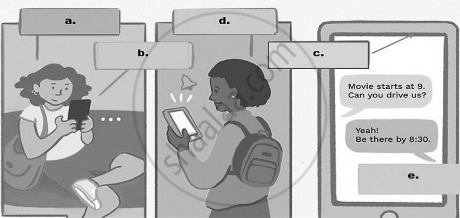
- Identify elements a, b, c and d in the communication process.
- Evaluate the significance of element ‘e’ in the communication process.
Explain merits of oral communication.
Differentiate between formal and informal organisations on the basis of
- origin,
- authority, and
- flow of communication.
Explain briefly any three semantic barriers to communication.
Explain the importance of communication in business.
Elucidate the types of communication based on area of operation.
L.ong Answer Type Questions
Explain the importance of communication in business.
Describe the elements of communication process with the help of a suitable diagram.
Explain merits of oral communication.
Write the disadvantages of oral communication.
Discuss the advantages of written communication.
Explain the disadvantages of written communication.
Give any eight distinctions between oral communication and written communication.
Explain the advantages of gestural communication.
Explain the disadvantages of gestural communication.
Discuss the advantages of visual communication.
Discuss the disadvantages of visual communication.
Explain the advantages of internal communication.
Explain the disadvantages of internal communication.
Discuss the advantages of external communication.
Discuss the disadvantages of external communication.
Written communication is the most common method of communication in a business organisation. Give reasons.
“Oral communication is an unreliable yet popular method of communication”. Discuss.
Explain the advantages of formal communication.
Explain the disadvantages of formal communication.
Discuss the advantages of informal communication.
Discuss the disadvantages of informal communication.
Describe the advantages of horizontal communication.
Describe the disadvantages of horizontal communication.
Explain the advantages of vertical communication.
Explain the disadvantages of vertical communication.
Differentiate between Internal and External communication.
Differentiate between horizontal communication and vertical communication.
Discuss in brief various barriers to communication.
Describe the recent trends in business communication.
Briefly explain any six reasons for the rising need for efficient communication.
Briefly discuss any three advantages of face-to-face communication.
Briefly discuss any three disadvantages of face-to-face communication.
Explain the two types of external communication.
List the components of a communication process.
Give any eight distinctions between oral communication and written communication.
Define communication.
Differentiate between formal and informal organisations on the basis of
- origin,
- authority, and
- flow of communication.
Explain the advantages of gestural communication.
Explain the disadvantages of gestural communication.
Discuss the types of communication on the basis of area of operation.
Manohar is a supervisor at the manufacturing unit of an automobile company. Most of his subordinates are not well educated. Manohar often finds that they are unable to understand his instructions.
Identify the barrier to communication in the given context. Suggest any three ways to overcome this barrier.
Oral communication is often considered a non-reliable medium that has no legal proof. However, it remains the most popular method of communication in organisations.
Give any four reasons to support the above statements.
Mr. Tyagi, CEO of P.K.C. Ltd. gave instructions to all the heads of the department for the upcoming project. The instructions needs to be communicated to the subordinates by a definite formal channel of communication but the subordinate at the lowest level were not able to understand instructions properly which leads to delay in completing the project. Identify and explain the barrier to communication. Also, suggest any two ways to overcome this barrier.
What is meant by diagonal communication?
Discuss in brief various barriers to communication.
Discuss in brief various barriers to communication.
"Oral communication is flexible." Defend or refute. Support your answer with the help of examples.
"Oral communication is imprecise in nature." Why? Also explain other four disadvantages of Oral Communication.
Explain any five ways of overcoming barriers to communication.
C. B. Gupta solutions for Business Studies [English] Class 12 ISC 14 Business Communication QUESTION BANK [Pages 264 - 271]
Why should a communicator be precise and brief while communicating?
In order to ensure completion of message one should check for the ‘five W questions’. List the ‘five W’ questions.
Explain the principle of using grapevine strategically in an organisation.
Why is communication called a two-way process?
Explain how attitude and opinion act as a barrier to effective communication.
Define ‘Visual communication’.
“Effective communication depends more on the message than on media”. Comment.
What is the importance of feedback in a communication process?
How communication is essential for maintaining interpersonal relationships.
What is horizontal communication?
What is Gestural communication?
What are the ways in which you can indulge in ‘gestural communication’?
What are semantic barriers of communication?
How can you overcome semantic barriers to effective communication?
Distinguish between verbal and non-verbal communication.
Explain the two types of vertical communication.
Give four advantages of video-conference.
How is e-mail different from video-conference?
Explain diagonal or cross-wise communication.
Explain the importance of communication in business.
Differentiate between formal and informal organisations on the basis of
- origin,
- authority, and
- flow of communication.
What are the measures to overcome barriers to effective communication?
Prateek is working in a multi-national company in Noida. He was running temperature for the last many days. When his blood was tested, he was found positive for malaria. He was admitted in the hospital and a blood transfusion was advised by the doctors as his condition was very serious. One of his colleagues sent a text message to his superior 'Mr. B. Chatterjee'. Mr. B. Chatterjee, immediately sent a text message to the employees of the organisation requesting them to donate blood for Prateek. When the General Manager came to know about it he ordered for fumigation in the company premises and for cleaning the surroundings.
- From the above paragraph quote lines that indicate formal and informal communication.
- State any two features of informal communication.
- Identify any two values that are being communicated to the society in the above case.
Evaluate the type of communication depicted in the given image:
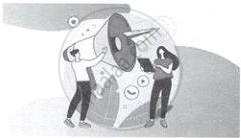
Read the passage given below and answer the questions that follow.
| Annie and Naveen are fresh Engineering graduates who have been appointed by Scottish Automobile Ltd. Equipped with the latest information, Annie wants to introduce some changes in the production of automobiles. She is hesitant to discuss her ideas with her superior, Mr. Shah. Hence, she discusses it with Naveen. Annie and Naveen make a power point presentation based on Annies ideas. On behalf of Annie, Naveen presents it to Mr. Shah, in the monthly review meeting. |
- Identify the barrier to communication that exists between Annie and Mr. Shah.
- Suggest any three ways in which the barrier to communication between Annie and Mr. Shah can be overcome.
- Name and explain the type of communication between
- Annie and Naveen.
- Naveen and Mr. Shah.
Subramanyam is a newly appointed Human Resource Manager in Times Ltd. in Punjab. He is a Tamilia basically. He is good at Tamil and English. Most of his subordinates belong to Punjab and they are not very much fluent in English. He feels it is very difficult to make them understand his instructions.
- Identify the concerned communication barrier.
- State the category of such barrier
- Explain any other categories of same barrier
The data below shows the results of a survey conducted by the Human Resources Department of XYZ Pvt. Ltd. to identify the most effective means of internal business communication.
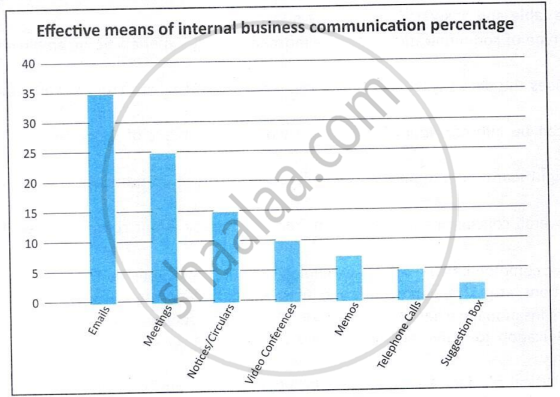
Read the data carefully and answer the questions that follows:
- With reference to the methods of communication used by XYZ Pvt. Ltd., identify one example each of:
- Written Communication
- Oral Communication
- Justify the use of meetings as a methods of communication by XYZ Pt. Ltd.
- Suggest any two limitations of using the suggestion box method to indicate why XYZ Pvt. Ltd. should avoid it.
- By providing any two reasons, explain why Emails have been the most effective method of communication for XYZ Pvt. Ltd.
The table shows the results of a survey conducted in the HR department of GlobalTech Ltd. to identify the major barriers to communication experienced by employees at different levels of the organization.
| Barriers to Communication | Percentage |
|---|---|
| Socio-psychological Barriers | 60% |
| Organsational Barriers | 20% |
| Physical Barriers | 12% |
| Semantic Barriers | 8% |
Analyze the table and answer the following questions:
- Which type of communication barrier is most commonly experienced by employees at GlobalTech Ltd.?
- What does the data suggest about the role of organisational structure in communication at GlobalTech Ltd.?
- What can be inferred about the physical work environment of GlobalTech Ltd. from the given data above?
- How significant are semantic barriers in affecting communication within the organisations?
- What overall conclusions can be drawn from the survey about communication barriers at GlobalTech Ltd.?
The graph below is based on 'Elite Enterprises Ltd.'
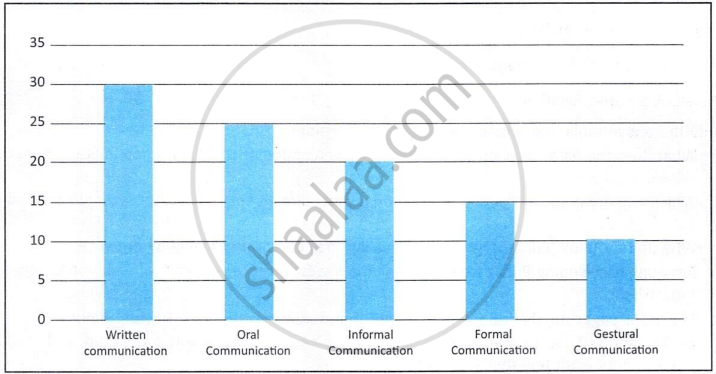
Observe the above graph and answer the questions given below:
- Which type of communication is used the most by employees in the organization?
- Compare the use of oral communication and informal communication. What does this indicate about workplace interaction?
- What does the relatively low use of gestural communication indicate about the organizations?
- What can be inferred about the balance between formal and informal communication in an organizations?
- Based on the data, what recommendations can be made to improve communication effectiveness in the organization?
A survey was conducted at Starline Industries Ltd. to understand employees' opinions on the importance of communication in achieving organisational goals.
| Areas where communication is considered important | Percentage of employees agreeing |
|---|---|
| Building Employee Morale | 30 |
| Improving Coordination | 25 |
| Enhancing decision making | 20 |
| Ensuring Clarity of instructions | 15 |
| Developing Public Relations | 10 |
Study the above table and answer the following questions:
- What does the data suggests about employees perception of communication in Starline Industries Ltd.?
- Which two areas show that communication is most directly related to internal organisational efficiency?
- Why do you think 'Enhancing decision making' has been rated highly by employees?
- Although 'Developing Public Relations' has the lowest percentage, why is it still importance for Starline Industries Ltd.
Solutions for 14: Business Communication
C. B. Gupta solutions for Business Studies [English] Class 12 ISC chapter 14 - Business Communication
Shaalaa.com has the CISCE Mathematics Business Studies [English] Class 12 ISC CISCE solutions in a manner that help students grasp basic concepts better and faster. The detailed, step-by-step solutions will help you understand the concepts better and clarify any confusion. C. B. Gupta solutions for Mathematics Business Studies [English] Class 12 ISC CISCE 14 (Business Communication) include all questions with answers and detailed explanations. This will clear students' doubts about questions and improve their application skills while preparing for board exams.
Further, we at Shaalaa.com provide such solutions so students can prepare for written exams. C. B. Gupta textbook solutions can be a core help for self-study and provide excellent self-help guidance for students.
Concepts covered in Business Studies [English] Class 12 ISC chapter 14 Business Communication are Overview of Business Communication, Importance of Communication in Business, Distinction Between Internal and External Communication, Communication> Formal Communication, Communication> Informal Communication or Grapevine, Distinction Between Formal and Informal Communications, Horizontal Communication, Communication, Vertical Communication, Diagonal Communication, Overcoming the Barriers to Communication, Current Trends in Business Communication, Elements of the Communication Process, Oral or Spoken Communication, Written Communication, Distinction between Oral Communication and Written Communication, Gestural Communication, Visual Communication, Distinction Between Gestural and Visual Communication, Internal Communication, External Communication, Barriers to Communication.
Using C. B. Gupta Business Studies [English] Class 12 ISC solutions Business Communication exercise by students is an easy way to prepare for the exams, as they involve solutions arranged chapter-wise and also page-wise. The questions involved in C. B. Gupta Solutions are essential questions that can be asked in the final exam. Maximum CISCE Business Studies [English] Class 12 ISC students prefer C. B. Gupta Textbook Solutions to score more in exams.
Get the free view of Chapter 14, Business Communication Business Studies [English] Class 12 ISC additional questions for Mathematics Business Studies [English] Class 12 ISC CISCE, and you can use Shaalaa.com to keep it handy for your exam preparation.
