C. B. Gupta solutions for Business Studies [English] Class 12 ISC chapter 7 - Staff Motivation [Latest edition]
Chapters
2: Job Analysis and Manpower Planning
3: Staff Recruitment
4: Staff Selection
5: Staff Training
6: Staff Morale
▶ 7: Staff Motivation
8: Staff Remuneration
9: Staff Leadership
10: Staff Appraisal
11: Staff Promotion and Transfer
12: Staff Separation
13: Emerging Trends in Human Resources
14: Business Communication
15: Business Correspondence
16: Reports and Report Writing
17: Various Business Entities
18: Sources of Business Finance
19: Globalisation
20: E-Business
21: Outsourcing
22: Business Regulators and Intermediaries
Advertisements
Advertisements
Solutions for Chapter 7: Staff Motivation
Below listed, you can find solutions for Chapter 7 of CISCE C. B. Gupta for Business Studies [English] Class 12 ISC.
Advertisements
C. B. Gupta solutions for Business Studies [English] Class 12 ISC 7 Staff Motivation EXERCISES [Pages 114 - 120]
Objective Type Questions MCQ's (Select the best Alternative)
Which of the following is not a part of Maslow's hierarchy of human needs?
Safety Needs
Training Needs
Esteem Needs
Physiological Needs
According to Maslow, needs are satisfied at last:
physiological
social
self-actualisation
safety
According to Maslow, needs are satisfied at first:
physiological
safety
social
esteem
Motivated employees are rewarded:
negative
positive
intrinsic
none of these
For efficient direction motivation is ______.
necessary
unnecessary
wastage of money
wastage of time
Motivational means should be determined on the basis of ______.
group
individuals
job
all of these
Which of the factors are Herberz theory?
Hygiene factors
Motivational factors
Both Hygiene factors and Motivational factors
None of the Hygiene factors and Motivational factors
From the following which of the following is/are non-monetary incentives?
Frine benefits
Status symbols
Allowances
All of these
Assertion (A): Maintenance Factors are required to support the mental health of employees.
Reason (R): Dissatisfiers operate to dissatisfy the employees when they are absent but their presence does not motivate them.
Both Assertion and Reason are true, and Reason is the correct explanation for Assertion.
Both Assertion and Reason are true, but Reason is not the correct explanation for Assertion.
Assertion is true and Reason is false.
Both Assertion and Reason are false.
Assertion (A): According to Maslow's hierarchy of needs, physiological needs are more fundamental than self-actualisation needs.
Reason (B): Physiological needs, such as food, water and shelter, form the base of Maslow's pyramid, while self-actualisation needs represent the higher level of personal growth and fulfilment in the hierarchy.
Both Assertion and Reason are true, and Reason is the correct explanation for Assertion.
Both Assertion and Reason are true, but Reason is not the correct explanation for Assertion.
Assertion is true and Reason is false.
Both Assertion and Reason are false.
Statement 1: Self-actualisation involves the pursuit of personal growth, creativity and fulfilment.
Statement 2: Individuals must achieve self-actualization before addressing their social needs
Both statements are true.
Both statements are false.
Statement 1 is true, but Statement 2 is false.
Statement 1 is false, but Statement 2 is true.
A person who is in the position of attempting to satisfy their needs at the most basic level is operating at the level of Maslow's needs hierarchy called the need for ______.
Self-actualization
Esteem
Physiological
Belongingness
According to Maslow’s hierarchy of needs, which of the following does not belong to safety needs?
Protection from fire and accident
Lack of economic security involving health and insurance
The desire for an orderly and predictable environment
The desire to know the limits of acceptable behavior
Sharman, a sales manager, achieved his sales target 10 days in advance. This achievement was displayed on the notice board and the CEO of the Company awarded a certificate for the best performance to him.
Name the incentive provided to Sharman.
Job Security
Bonus
Recognition
Promotion
The advantages of incentive payments are
- Ease in the introduction of new machines
- Better utilization of the resources
- Reduced absenteeism and turnover
- Increased Scrap
Choose the most appropriate answer from the options given below:
A, B only
B, C only
B, C, D only
A, B, C only
Match the columns:
| Column I | Column II |
|---|---|
| I. Physiological Needs | a. Job title |
| II. Safety Needs | b. Basic Salary |
| III. Social Needs | c. Achievement of goals |
| IV. Esteem Needs | d. Cordial relations with colleagues |
| V. Self-actualisation Needs | e. Pension Plan |
Choose the correct code from the following options:
I - b, II - e, III - d, IV - a, V - c
I - a, II - b, III - c, IV - d, V - e
I - d, II - a, III - e, IV - b, V - c
I - c, II - a, III - d, IV - e, V - b
What does the following image represent?

Status symbol
Bonus
Appreciation of Work
Suggestion scheme
Mr. Hill, a High School teacher was appreciated by many students, as his focus was on team building, encouraging creative thinking, and paying attention to the students’ personal problems on an individual basis. However, during a class test, most students did not score good marks. The management felt that a major objective of teaching was not achieved.
Where will Mr. Hill be placed on Blake and Mouton’s managerial grid?
1,9
5,5
9,1
9,9
Which of the following, is NOT an assumption of Maslow’s theory of the hierarchy of human needs?
- A satisfied need does not act as a motivator.
- Human needs may not follow a hierarchical order.
- An individual's behaviour at any time is guided by multiplicity of motive.
- An individual will attempt to satisfy one category of need at one time.
Choose the correct option based on the above situation.
Both (i) and (ii).
Both (ii) and (iii).
Both (iii) and (iv).
Both (i) and (iv).
With reference to non-monetary incentives offered by an organization, identify the odd one out from the following:
Appreciation of work
Participation I management decisions
Job security
Medical reimbursement
XYZ Ltd. follows a compensation policy that focuses solely on financial incentives as it believes that money is a great motivator. Despite receiving handsome salaries, several managers have recently resigned from the company.
Which one of the following is most likely the reason for their resignation?
The managers are satisfied with only financial rewards.
The managers are satisfied with non-monetary benefits.
The managers feel that the monetary incentives are too high.
The managers want both monetary as well as non-monetary incentives.
Fill in the blanks with suitable words given in brackets.
______ may satisfy physiological, safety and social needs.
hygiene
money
leave
For efficient direction motivation is ______.
necessary
unnecessary
wastage of money
wastage of time
Motivational means should be determined on the basis of ______.
group
unnecessary
wastage of money
wastage of time
______ propounded the "Need Hierarchy Theory"?
A. Maslow
Herzberg two factor theory
Likert
None of these
According to Maslow human needs are self actualisation, esteem needs, social needs, safety needs and ______.
hygiene needs
psychological needs
motivational needs
______ incentives of motivation are tangible and measureable.
Flexible work hours, additional training opportunities, or the ability for an employee to take time off to go to school are examples of ______.
Monetary incentives
Non-monetary incentives
In Herzberg’s Two-Factor Theory, having well-lit workspaces is an example of a ______ factor.
As per Maslow’s classification of human needs, safety needs consist of physical safety and ______ safety.
True or False.
Safety needs are provisions against deprivation in the future.
True or False.
Maslow’s hierarchy of needs and Herzberg’s two-factor theories are related to motivation.
True or False.
Motivation can be positive or negative.
True or False.
Motivation and morale are exactly the same and can be used interchangeably.
True or False.
Herzberg’s two-factor theory divides job factors into motivators and hygiene factors, where hygiene factors alone can increase job satisfaction.
True or False.
Monetary incentives are generally given by the organisation to motivate the non-managerial employees.
Very Short Answer Type Questions
Why it is so that motivation is a complex process?
What do you mean by employees empowerment?
Who propounded the ‘need hierarchy’ theory of motivation?
What role does motivation play in reducing absenteeism?
How does motivation change the negative attitude of employees to positive attitude?
What is psychological safety?
The willingness to do the certain work depends on what?
Name the need which is satisfied first of all.
What do you mean by physical safety?
State the assumptions of ‘Maslow’s Need hierarchy Theory of motivation’.
How is motivation different from motivator?
How does motivation improve efficiency and facilitate accomplishment of organisational goals?
Motivation is a continuous process. Prove it.
How does motivation improve the efficiency of workers in an organisation?
Name the term used in management which stimulates people to take up work voluntarily.
What is meant by motivation?
Name the term used in management which stimulates people to take up work voluntarily.
Give an example of ‘Employee Recognition Programmes’ as a non-financial incentive.
Give any two characteristics of ‘Organisational Climate’ that influence the behaviour of individuals and act as a non-financial incentive?
How Motivation produces goal directed behaviour?
Name the first need as given in Maslow’s Hierarchy of Human Needs.
Give any two examples of employee recognition as a non-monetary incentive.
Why is Herzberg’s theory of motivation known as two factor theory?
| Campaigns in Africa to stop polio and other diseases have a more stable, better-motivated workforce thanks to the World Health Organisation (WHO)’s collaboration with countries and partners to pay frontline health workers through their mobile phones instead of in cash. “Over 80 percent of workers are saying they prefer the digital payments.” said Ahmed Hamani Djibo, head of WHO's Digital Finance Team. |
What type of human needs are being met in the above scenario, as per Maslow's theory of the hierarchy of needs?
Viking Cruises, a luxury tour company offers exclusive experiences at a premium price. For people opting for these tours, which need would be satisfied as per Maslow’s Hierarchy of Human Needs?
Short Answer Type Questions
Define motivation.
“Motivation is the core of management.” Comment.
Distinguish between monetary and non-monetary incentives.
With the help of a diagram, explain the hierarchy of needs as given by Maslow.
Give some examples of ‘non-monetary incentives’ which may facilitate better work and harder work.
Explain self-actualization.
Define motivation.
Name any two incentives to motivate employees, besides money.
How can safety needs of an employee be satisfied by the employer?
State and explain any four non-monetary incentives that can be used to motivate employees.
‘Safety needs’ of an employee can be satisfied in either a positive or negative manner. Explain.
Enumerate any four human needs according to Maslow’s hierarchy.
Name any four non-monetary incentives that may be used in an organization.
Briefly explain the two types of esteem needs, as per the human needs stated by Maslow.
According to Maslow, one of the human needs deals with the realisation of one’s own potential. Name this human need.
Under special circumstances, low morale of employees may lead to high productivity.
State any two features of staff motivation.
| Kavya is working in a company on the permanent basis. As per the job agreement she had to work for 8 hours a day and was free to work overtime. Kavya worked overtime. But even after working for long hours and putting in her best efforts, no recognition was given to her by her boss. Due to overtime she fell ill and had to take leave from her work. No one showed concern and enquired about her health. She realised that she was fulfilling only some of her needs while some other needs still remained to be fulfilled. |
- Identify and explain the needs of Kavya discussed in the above para, by quoting the lines.
- Also explain two other needs of Kavya followed by the above needs, which still remained to be satisfied
With reference to Maslow’s Theory of the Hierarchy of Human Needs, explain the following:
Physiological Needs
With reference to Maslow’s Theory of the Hierarchy of Human Needs, explain the following:
Social Needs
Long Answer Type Questions
What is meant by motivation?
Explain motivation’s importance in staff management.
Explain the factors which influence motivation of staff.
Enumerate any four human needs according to Maslow’s hierarchy.
Critically examine Maslow’s concept of ‘hierarchy of human needs’ as a basis for a theory of motivation.
How is motivation different from morale?
Define motivation.
Enumerate any four human needs according to Maslow’s hierarchy.
What is the relevance of Maslow’s theory?
“Motivation is the core of management.” Comment.
Enumerate any four human needs according to Maslow’s hierarchy.
State and explain any four non-monetary incentives that can be used to motivate employees.
Money is the biggest but not the only motivator. Justify.
State Maslow’s need satisfaction theory.
Enumerate any four human needs according to Maslow’s hierarchy.
What is meant by motivation?
As a manager of growing textile factory, mention any six incentives for your workers. Explain as to how each one of them will help you in motivating the workers.
Define motivation.
Differentiate between monetary and non-monetary factors affecting motivation.
State and explain any four non-monetary incentives that can be used to motivate employees.
With the help of a diagram, explain the hierarchy of needs as given by Maslow.
“A more complete theory of motivation recognises that a person works to fulfil a variety of needs.” Explain.
Define motivation.
State any two features of staff motivation.
How is Maslow’s Theory related with the Herzberg’s Theory?
Briefly explain the two factors, as given by Herzberg, that affect the satisfaction and dissatisfaction of employees.
Name any two incentives to motivate employees, besides money.
Enumerate any four human needs according to Maslow’s hierarchy.
How does motivation improve efficiency and facilitate accomplishment of organisational goals?
Money is not the only motivator. Then what else is required to motivate employees? Explain by giving any four points.
Explain the Herzberg’s Theory of motivation with reference to the given image:

Observe the picture given and answer the questions that follow:
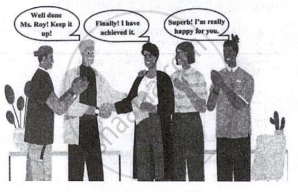
- Identify the factor indicated in the above image as per the Two-factor theory of Herzberg.
- Which need of Ms. Roy is being satisfied as per Maslow’s Hierarchy of Human Needs?
- Briefly explain the need of Ms. Roy that is being satisfied.
With reference to Herzberg’s Two-factor Theory, explain the motivational factors.
With reference to Herzberg’s Two-factor Theory, explain the hygiene factors.
C. B. Gupta solutions for Business Studies [English] Class 12 ISC 7 Staff Motivation QUESTION BANK [Pages 120 - 128]
Do you agree that Motivation can be either positive or negative?
Are Motive and Motivation synonymous?
“Performance is a function of ability, technology and motivation.” Explain.
“Man does not live by bread alone.” Explain.
Distinguish between pecuniary and non pecuniary incentives.
How is Maslow’s Theory related with the Herzberg’s Theory?
Distinguish between Maintenance Factors and Motivational Factors given by Herzberg.
“Maslow's hierarchy of needs does not provide a complete solution to the complex problem of motivating people.” Explain.
Compare Maslow’s Theory and Hezrlerg’s theory.
State any two features of staff motivation.
“Man is a wanting animal, as soon as one of his needs is satisfied another appears in its place.” Explain this statement with reference to the motivation.
State few maintenance factors as per Herzberg’s Two Factor Theory.
Identify the non-financial incentives in the following case:
A leading software company has set up a suggestion box system in order to involve its employees. exercise is allowed only to the members of the organisation. The result is an increased involvement the employees in issues related to the organisation.
Identify the non-financial incentives in the following case:
‘Step up’ is a leading soft drinks maker. They have made up arrangements at the workplace for the employees to make their work more meaningful. They will be provided opportunities for personal growth. The outcome has been an increase in motivation for the employees at the place of work itself.
Identify the non-financial incentives in the following case:
An automobile company is making arrangements for appropriate skill development programmes. They have chalked out a sound promotion policy to give more growth opportunities to the employees.
| Anuroop runs a law firm in Hyderabad. His firm offers valuable financial and legal consultancy services to the clients. Whenever the firm hires any new employees, on the first day of their joining, they are welcomed to the organisation and are given details about hours of work, holiday requests, sickness procedure, dress code, lunch arrangements, introduced to the daily operations and key people in the workplace, etc. They are also familiarized with the organizations’ policies and procedures, including complaints and dispute resolution, sexual harassment, emergency exists and evacuation procedure. |
In the context of the above case:
Identify and explain the human needs of the new employees that the being fulfilled by Anuroop through this training.
| Manav wanted to bring some changes in his company. One of those changes was the establishment of new software in the organisation. The software has the capability to judge the performance of all the employees. Thus it makes them more accountable. However, recently it so happened that the employees resisted Manav's decision. After a lot of thinking on the issue he decided to call a meeting to address their needs and performance. He told them that with the installation of the new software their needs would be fulfilled and the best performing employee would be rewarded. Thus he was able to bring down the resistance level of the employees. |
- Which concept of human resource management is applied by Manav in the above case?
- Which one benefit of this concept has been highlighted in the above case?
| A company has a number of employees who don't harbor good feelings for the organisation. They don't care whether the organisation is progressing or not. Some of them even have a negative attitude towards the management. When a local newspaper wanted to find out the reason for the declining productivity of the organisation it was found that it was mainly due to the lack of any incentives in the organisation. Employees were not awarded for increasing the output of the organisation. |
- What do you think needs to be done in such circumstances?
- What could be the positive outcome of your step?
| In a renowned hospital having 300 beds, the CEO of the hospital congratulates the exceptionally performing employees by meeting in person. Sometimes the name of the employee of the month is displayed on the notice board at the main entrance along with his/her photograph. Recently the company went a step ahead and distributed T-shirts to the employees who have been among the top 3 performers. On the Employee Day every year employees who contribute a lot are either rewarded or awarded. |
- In the above case which type of incentive has been used by the company to improve employee performance?
- Which type of incentive is this?
- Also give the definition of this type of incentive.
| ‘Hats Off’ is an apparel making company. It has recently decided to make the job environment better by redefining the workplace for the employees by designing jobs having greater variety of content. This has definitely increased the interest of employees in their work. This step of the Company has earned a favorite mention in a national newspaper. The promotion policy of the Company has now been made more effective by allowing employees to grow to the higher levels. Many of the employees had earlier complained of fear of getting fired. The Company has clarified its stance on this and told them not to worry by assuring them permanency after crossing the ad hoc period of six months. With everything going right for the organisation the top management has started devoting a lot of time on special features of the internal environment which will distinguish the organisation from other companies in the industry. The employees know that working in this organisation will only add to their good track record. The Company assures the employees a higher ranking in the organizational set up, provided one works hard, with authority, rewards, recognition and better perquisites. With such an effort, the organisation is geared to touch new heights. |
Which non-financial incentives have been highlighted in the above case?
Scenario 1: A customer service representative is given the authority to make decisions regarding refunds and discounts for dissatisfied customers.
Scenario 2: A customer service representative is assigned to additionally respond to live chat inquiries, handling email correspondence, and conducting customer satisfaction surveys.
- Identify the distinct approaches demonstrated in each scenario regarding the (empowerment and broadening of) job responsibilities of customer service representatives.
- In what way, does the job satisfaction experienced in Scenario 1 differ from Scenario 2?
- Identify the level at which the customer service representative in Scenario 1 finds satisfaction as per Maslow’s Hierarchy of Human Needs. Justify the answer.
| Today’s successful enterprises prioritise engaged human resources, making it the key factor over technology, innovation, and strategy. People engagement is rooted in corporate culture emphasising equity, empowerment, inclusion, skill enhancement, diversity, and empathy. Leadership strategies encompass cross-functional collaboration, mentorship, clear employee-centric communication, objectivity, integrity, and transparency. Fostering unit-level ambassadorship, work-life balance, trust, empowerment, and accountability results in high-performance teams and a strong corporate culture. Building strong leaders translates to engaged teams and overall corporate excellence" shared Amit Goenka, Managing Director & Chief Executive Officer, Nisus Finance. |
- What factor of motivation does Amit Goenka’s emphasis evoke, and how does it underscore its relevance in fostering a thriving workplace for an employee?
- How do Amit Goenka’s efforts to cultivate values such as equity, empowerment, and inclusion in organisations correlate with different tiers of Maslow’s hierarchy of needs theory?
- If the described scenario is implemented within an organisation, it would align with which category of the Morale Productivity Matrix?
The following table demonstrate the relationship between Staff Motivation and Productivity. Study the trend in the given table and answer the questions that follow:
| Month | Motivation Score (Out of 10) | Productivity Index (Units per employee) |
|---|---|---|
| January | 4.0 | 58 |
| February | 5.5 | 67 |
| March | 6.0 | 71 |
| April | 6.8 | 77 |
| May | 7.5 | 83 |
| June | 8.0 | 89 |
Questions:
- Which month shows the lowest motivation score?
- What might have contributed to the steady increase in staff motivation?
- Describe the trend observed between staff motivation and productivity.
- What conclusion can be drawn about the effect of motivation on employee efficiency?
The following table studies on How the Frequency of Employee Recognition Affects Their Monthly Work Output.
| Month | Recognition Instances/Month | Average Output (Units) |
|---|---|---|
| January | 1 | 62 |
| February | 2 | 68 |
| March | 3 | 74 |
| April | 4 | 80 |
| May | 5 | 85 |
| June | 6 | 91 |
Study the above schedule and answer the following questions:
Questions:
- What pattern do you observe between recognition and output?
- What type of motivation does recognition represent?
- Why is recognition effective even without financial reward?
- Give an opinion to conclude the study of the schedule.
ABC manufacturing Ltd. produces automobile parts. The company’s noticed a decline in productivity over the past six months. To address this, they introduced two types of incentive schemes for their employees:
- Monetary Incentives:
- 10% performance-based bonus for meeting monthly production targets
- Overtime pay for extra working hours
- Non-Monetary Incentives:
- “Employee of the month” recognition program
- Free skill development workshops
- Better cafeteria and recreation facilities
After three months of implementing these incentives, the management conducted a survey and collected the following data:
| Incentive type | % of Employees Motivated | Change in Output | Employee Feedback Summary |
|---|---|---|---|
| Monetary Incentives | 65 | 12% | Felt rewarded for extra effort |
| Non-Monetary Incentives | 80 | 18% | Felt valued and more loyal to the company |
Questions:
- Define monetary and non-monetary incentives.
- From the data above, which type of incentive had a greater impact on employee efficiency? Give reasons.
- Explain how on-monetary incentives contribute to long-term employee efficiency.
- Identify one possible limitation of relying only on monetary incentives.
- Suggest one more incentive (monetary or non-monetary) that ABC Manufacturing Ltd. could introduce to further improve performance.
Rainbow Foods Ltd. noticed that employees in its packaging department were often absent and less productive. The management introduced several motivational practices like regular feedback meetings, appreciation notes and employee suggestion schemes. After three months, HR compared productivity and teamwork levels before and after the motivation program.
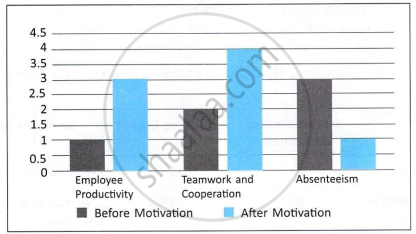
Observe the graph and answer the following questions:
- What change is observed in employee productivity after the motivation program?
- What does the data suggest about the relationship between motivation and teamwork?
- How did staff motivation impact absenteeism?
- Based on the graph, what can you infer about the importance of motivation in improving overall performance?
- Suggest one non-financial way the company could maintain this improvement.
Solutions for 7: Staff Motivation
C. B. Gupta solutions for Business Studies [English] Class 12 ISC chapter 7 - Staff Motivation
Shaalaa.com has the CISCE Mathematics Business Studies [English] Class 12 ISC CISCE solutions in a manner that help students grasp basic concepts better and faster. The detailed, step-by-step solutions will help you understand the concepts better and clarify any confusion. C. B. Gupta solutions for Mathematics Business Studies [English] Class 12 ISC CISCE 7 (Staff Motivation) include all questions with answers and detailed explanations. This will clear students' doubts about questions and improve their application skills while preparing for board exams.
Further, we at Shaalaa.com provide such solutions so students can prepare for written exams. C. B. Gupta textbook solutions can be a core help for self-study and provide excellent self-help guidance for students.
Concepts covered in Business Studies [English] Class 12 ISC chapter 7 Staff Motivation are Overview of Staff Motivation, Meaning and Definition of Staff Motivation, Motivation> Motivation Process, Characteristics of Staff Motivation, Difference Between Motivation and Morale, Motivation> Importance of Motivation, Factors Influencing Motivation, Difference Between Financial/Monetary and Non-Financial/Non-Monetary Incentives, Maslow's Theory of the Hierarchy of Human Needs, Herzberg's Two Factor Theory, Critical Appraisal of Herzberg's Theory, Relationship Between Maslow and Herzberg Theories.
Using C. B. Gupta Business Studies [English] Class 12 ISC solutions Staff Motivation exercise by students is an easy way to prepare for the exams, as they involve solutions arranged chapter-wise and also page-wise. The questions involved in C. B. Gupta Solutions are essential questions that can be asked in the final exam. Maximum CISCE Business Studies [English] Class 12 ISC students prefer C. B. Gupta Textbook Solutions to score more in exams.
Get the free view of Chapter 7, Staff Motivation Business Studies [English] Class 12 ISC additional questions for Mathematics Business Studies [English] Class 12 ISC CISCE, and you can use Shaalaa.com to keep it handy for your exam preparation.
