C. B. Gupta solutions for Business Studies [English] Class 12 ISC chapter 9 - Staff Leadership [Latest edition]
Chapters
2: Job Analysis and Manpower Planning
3: Staff Recruitment
4: Staff Selection
5: Staff Training
6: Staff Morale
7: Staff Motivation
8: Staff Remuneration
▶ 9: Staff Leadership
10: Staff Appraisal
11: Staff Promotion and Transfer
12: Staff Separation
13: Emerging Trends in Human Resources
14: Business Communication
15: Business Correspondence
16: Reports and Report Writing
17: Various Business Entities
18: Sources of Business Finance
19: Globalisation
20: E-Business
21: Outsourcing
22: Business Regulators and Intermediaries
Advertisements
Advertisements
Solutions for Chapter 9: Staff Leadership
Below listed, you can find solutions for Chapter 9 of CISCE C. B. Gupta for Business Studies [English] Class 12 ISC.
Advertisements
C. B. Gupta solutions for Business Studies [English] Class 12 ISC 9 Staff Leadership EXERCISES [Pages 158 - 163]
Objective Type Questions MCQ's (Select the best Alternative)
The leader possess ______.
intelligence
foresightedness
self-confidence
all of these
The leader takes work from his subordinates ______.
by tact
by rod
by threatening
none of these
The manager is ______.
boss
owner
leader
none of these
The leader has ______ authority.
informal
formal
personal
government
Democratic leadership also known as ______.
Free Rein style
Participative style
dominating style
hands off style
Where has the leadership continuum concept been developed?
UK
India
USA
Germany
Leadership is a ______ process.
Complex
Simple
Manifold
Pure
Assertion (A): Effective leadership is essential for successful management.
Reason (R): Leaders inspire and motivate employees to achieve organizational goals.
Both (A) and (R) are true and (R) is the correct explanation of (A).
Both (A) and (R) are true, but (R) is not the correct explanation of (A).
(A) is true, but (R) is false.
(A) is false, but (R) is true.
Assertion (A): Democratic management is based on the principle of people's participation.
Reason (R): A leader who takes administrative decision by himself/herself believes in democratic procedures.
Both (A) and (R) are true and (R) is the correct explanation of (A).
Both (A) and (R) are true, but (R) is not the correct explanation of (A).
(A) is true, but (R) is false.
(A) is false, but (R) is true.
Given below are two statements:
Statement I: Under Free rein leadership styles, there is a democratic leader who develops plans and staff evaluate their own performance.
Statement II: Under Democratic leadership styles, there is a delegative leader who remains unavailable and the staff feels insecure.
In the light of the above statements, choose the most appropriate answer from the options given below:
Both Statements I and II are correct.
Both Statements I and II are incorrect.
Statement I is correct but Statement II is incorrect.
Statement I is incorrect but Statement II is correct.
Which of the following statements is/are correct?
- Manager maintain while leaders develop
- Managers inspire while leaders control
- Leaders are thought to do things right, managers do the right things
- Managers originate while leaders imitate
(i), (ii), (iii) are correct.
(i), (ii) are correct.
(i), (ii), (iii), (iv) are correct.
(i), (iii) are correct.
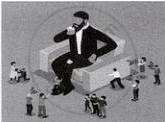
Which type of leadership does the following picture illustrate?
Free-Rein
Democratic
Autocratic
Bureaucratic
During the period of a social emergency the autocratic leader gets easier popularity than the democratic leader because ______.
He exercises exclusive powers to reorient the group according to immediate objectives
He executes his orders in a repressed and rigid manner to create panic
He shines for shorter span on the political scene
He exists and enjoys a very brief span of his leadership
Managerial Grid model of leadership has concern for ______.
Process and project
People and Product
Pre-requisites and Plans
Planning and process
Assertion (A): Leadership and management are interchangeable terms.
Reason (R): Both leadership and management involve guiding and influencing individuals to achieve organisational goals.
Both (A) and (R) are true and (R) is the correct explanation of (A).
Both (A) and (R) are true, but (R) is not the correct explanation of (A).
(A) is true, but (R) is false.
(A) is false, but (R) is true.
| Yash worked in business development unit of an Edtech start up. He always achieve the targets on time and recently achieved his sales target one week in advance. This achievement was displayed on the notice board and the CEO of company awarded a certificate for the best performance to him. Due to his consistent performance, he was promoted to the post of sales manager. He encourages his team to form their own objectives and take decisions. He respects their opinions and support them. He also promotes informal group within the department so that the team members develop a sense of belongingness. |
What was the leadership style followed by Yash?
Authoritative
Democratic
Both (a) and (b)
Laissez Faire
Management : Formal Authority :: Leadership : ______
Adapting authority
Accepting authority
Situational authority
None of these
Shivam, a Senior Manager at a leading software development company, has selected 4 members from his team to travel with him to the overseas client site for product installation. He calls for a team meeting & explains the reasons for his selection.
Where does Shivam's leadership style stand in the Leadership continuum spectrum?
The manager sells the decision.
The manager presents ideas and invites questions.
The manager makes the decision and announces it.
The manager presents a tentative decision subject to change.
Fill in the blanks with suitable words given in brackets
In ______ leadership style, the leader has all to power.
Autocratic
Democratic
Laissez Fair
A democratic leader makes decisions ______.
without consulting his followers
jointly with his followers
on its own
A leader may use ______ style/styles over a period of time.
one
two
all
______ style, gives the subordinate maximum scope of self development.
Autocratic
Democratic
Laissez Fair
The ______ style of leadership reduces resistance to change and increases acceptance of new ideas.
Leadership is mainly a part of ______.
Directing
Controlling
A leader stresses his prerogative to decide and gives ______ freedom to the followers.
No
Complete
Partial
Laissez faire leadership is also known as ______.
Hands-off style
Participative approach
______ style of leadership does not allow much room for employee decision-making.
True or False.
Leadership style refers to a leader's behaviour.
True or False.
A team leader who balances high productivity with employee satisfaction, as shown on Blanke and Mouton's Managerial Grid, would adopt the 'Team Management' style.
True or False.
In modern times, autocratic leadership is more suitable.
True or False.
Ideally, all managers should be leaders.
True or False.
Effective leaders do not need a high degree of knowledge about the company, industry, and technical matters.
True or False.
The challenge for many managers is learning how to become an effective team leader.
True or False.
Situational leadership is an ideal type of leadership as it provides strong motivation and satisfaction to the leader.
Very Short Answer Type Questions
Who is the leader?
‘Leadership is a part of management but not all of it.’ Clarify.
‘Leadership transforms potential into reality.’ How?
All managers are leaders, but all leaders are not managers. Do you agree?
Give the meaning of the ‘Democratic style of Leadership’.
Briefly explain any three leadership styles.
What type of change is brought in by leadership?
What type of relations does a leader maintain with his follower?
Which style of leadership does not like interference by others?
“Leadership is reciprocal.” Do you agree? Give reason to your answer.
Which leadership style is considered as a classical approach?
How democratic leadership facilitates the development of future leaders?
“The continuum approach to leadership provides a wide range of leaders behavior.” Justify.
Name the leadership style that enables quick decision making.
As per the Blake and Mouton Managerial Grid, name the 5, 5 leadership style combination.
Short Answer Type Questions
Define leadership.
What is autocratic leadership?
There is a world of difference between consultative and participating styles of leadership. Bring out the implications of this statement.
“Participative style is in tune with the norms of democracy.” Examine this statement.
“A trade union leader is born, not made.” Give arguments for or against this proposition.
What is meant by Laissez-Faire leadership?
“Leadership is situational.” Comment.
Autocratic leadership is ideal for blue-collar workers. Justify.
How is a leader different from a manager?
Briefly explain any three leadership styles.
Give any two advantages of the Laissez-Faire style of leadership.
Give any two differences between leadership and management.
Under the democratic leadership style, the leader gives complete freedom to his followers. State true or false with reason.
True
False
“Leadership presupposes the existence of followers.” Justify.
With reference to the Managerial Grid given by Blake and Mouton, explain the following:
Country Club
With reference to the Managerial Grid given by Blake and Mouton, explain the following:
Impoverished
“A leader may use all the three leadership styles over a period of time but one style tends to predominate as his normal way of leadership.” Do you agree? Give reason to justify your answer.
“There is resistance to change as workers feel harassed and disturbed.” Why?
Explain the concept of situational leadership.
Explain the concept of situational leadership.
Long Answer Type Questions
What is meant by leadership?
Give any two differences between leadership and management.
Explain different leadership styles, bringing out clearly the merits and demerits of each style.
Give any four differences between the Autocratic style of leadership and the Democratic style of leadership.
“Leadership style is the varying degree of use of authority by the leader and the ‘area of freedom given’ to the subordinates.” Discuss.
Explain different leadership styles, bringing out clearly the merits and demerits of each style.
Explain different leadership styles, bringing out clearly the merits and demerits of each style.
Define leadership.
Briefly explain any three leadership styles.
Describe the Managerial Grid.
Write a short note on authoritative leadership.
Briefly explain any three leadership styles.
Write a short note on situational leadership.
Give the meaning of the ‘Democratic style of Leadership’.
State any two advantages of democratic leadership.
With reference to democratic leadership, answer the following:
State any two disadvantages.
Specify any two conditions where the democratic leadership style is most effective.
Mr. Khatri is the Head of the Sales Department in Global Max Ltd. He used different leadership styles in different situations.
- He took all decisions by himself when they have to meet the target in limited time.
- When the Sales Department had to predict future sales of the coming year, Mr. Khatri considered the opinions and suggestions given by his subordinates.
- For the routine activity/work, he gives full freedom to take decisions to his subordinates.
Identify and explain the leadership styles used in the above situations.
Blake and Mouton have identified five combinations in their graphic model of alternative combinations of leadership styles or behaviours. With reference to the above statement, explain any four such combinations.
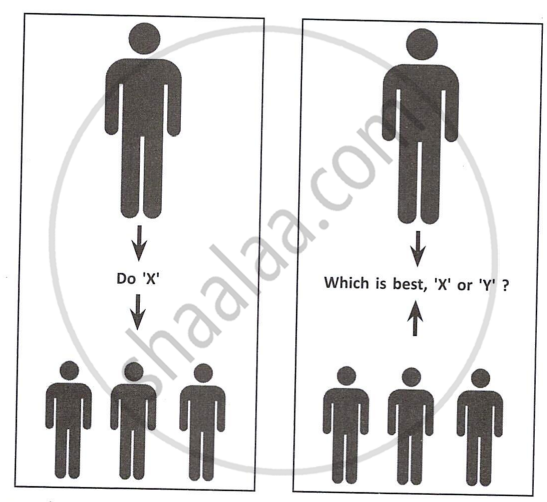
- Identify the two styles of leadership depicted in the above images.
- State any one feature of each of the above styles of leadership.
Explain the concept of situational leadership.
“Authoritarianism is gradually being resisted.” Throw some light on the statement.
“Leadership style is the varying degree of use of authority by the leader and area of freedom for subordinates.” What does this statement suggest? Explain the concept suggested in the statement.
Give any four differences between the Autocratic style of leadership and the Democratic style of leadership.
C. B. Gupta solutions for Business Studies [English] Class 12 ISC 9 Staff Leadership QUESTION BANK [Pages 163 - 167]
“Leadership is required only for less efficient subordinates.” Do you agree?
Why leadership considered as the most important element of directing function of management?
All managers are leaders, but all leaders are not managers. Do you agree?
“A trade union leader is born, not made.” Give arguments for or against this proposition.
Autocratic leadership is ideal for blue-collar workers. Justify.
“Participative style is in tune with the norms of democracy.” Examine this statement.
“Leadership is situational.” Comment.
Give any four differences between the Autocratic style of leadership and the Democratic style of leadership.
Describe the Managerial Grid.
| Aarav was working as a supervisor with ‘Neer Purifier Ltd.’ which was producing water purifiers. The target of the company was to produce 200 water purifiers every day. His job was to make sure that work goes on smoothly and there was no interruption in production. To achieve this, he always gives orders and insists that they are obeyed. He believes that reward or punishment both can be given depending upon the performance. |
- Identify and describe the leadership style being adopted by Aarav.
- Evaluate the leadership style critically.
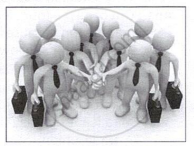
Identify the leadership style from the following image and evaluate the same.
Chanda Kochar is a big believer in having hands-on experience as it lets individuals test the execution of their decisions and better understand the thought process involved.
Identify and explain the leadership style of Chanda Kochar. Justify the reason given by Chanda Kochar for adopting the above leadership style.
Draw the managerial grid. Out of the possible combinations, name and explain any one extreme combination.
The Vice President (Marketing) of Pratiksha Ltd. Mr. Mehta gives complete autonomy to his team to plan and execute their work. Mr. Mehta intervenes only when the team seeks his suggestions or support. On the other hand, the Vice President (Production), Mrs. Kapoor, regularly interacts with her team and makes decisions collaboratively.
- Name the leadership style where the manager solely takes decisions and announces them. (1)
- Suggest a situation in which a centralised leadership style in an organisation could act as a morale depressant. (1)
- Explain any two differences between the leadership styles demonstrated by Mr. Mehta and Mrs. Kapoor as described in the case. (2)
Study the below pie chart and answer the following questions:
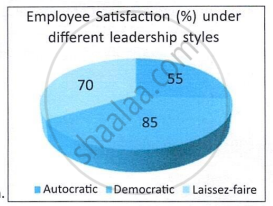
- Which leadership style has the highest employee satisfaction?
- What might be one reason for the difference in satisfaction between Democratic and Autocratic leadership styles?
- Which leadership style might lead to more employee turnover? Explain.
- Suggest one situation where autocratic leadership might still be more effective than Democratic leadership.
Productivity under Situational Leadership (Over 4 Quarters)
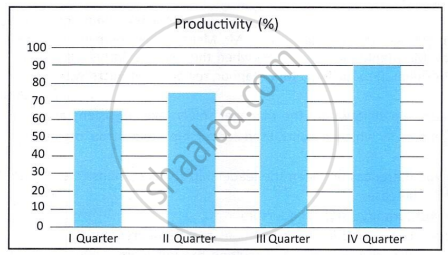
- Describe the trend of productivity over the four quarters.
- What does this trend suggest about the effect of situational leadership?
- Give one reason for the steady improvement.
- What might happen if the leader used only one fixed style?
- Suggest one way a leader can assess which style to apply?
The table show below illustrates the Manager's Concern Levels
| Manager | Concern for People | Concern for Production | Leadership Style |
|---|---|---|---|
| A | Low | Low | Impoverished |
| B | High | Low | Country Club |
| C | Low | High | Task-Oriented |
| D | High | High | Team Management |
| E | Moderate | Moderate | Middle-of-the-Road |
Study the above table and answer the following questions:
- Which manager shows the most balanced approach to leadership?
- Why might Manager C face resistance from employees over time?
- What type of work environment is likely to exist under Manager B?
- Why Manager D’s leadership is considered ideal according to the Blake and Mouton Grid?
- How could Manager A’s leadership style affect team motivation and productivity?
The following graph represents the Employee Motivation and Organisational Efficiency.
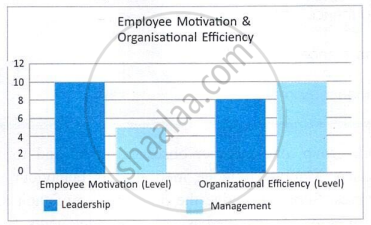
Observe the graph and answer the following questions:
- Which function produces higher employee motivation?
- What does this suggest about the emotional influence of leadership?
- Why might management achieve higher efficiency than leadership?
- What could be the effect of having only leadership without management?
- What conclusion can you draw about combining the two?
Solutions for 9: Staff Leadership
C. B. Gupta solutions for Business Studies [English] Class 12 ISC chapter 9 - Staff Leadership
Shaalaa.com has the CISCE Mathematics Business Studies [English] Class 12 ISC CISCE solutions in a manner that help students grasp basic concepts better and faster. The detailed, step-by-step solutions will help you understand the concepts better and clarify any confusion. C. B. Gupta solutions for Mathematics Business Studies [English] Class 12 ISC CISCE 9 (Staff Leadership) include all questions with answers and detailed explanations. This will clear students' doubts about questions and improve their application skills while preparing for board exams.
Further, we at Shaalaa.com provide such solutions so students can prepare for written exams. C. B. Gupta textbook solutions can be a core help for self-study and provide excellent self-help guidance for students.
Concepts covered in Business Studies [English] Class 12 ISC chapter 9 Staff Leadership are Overview of Staff Leadership, Meaning and Definition of Leadership, Distinction Between Leadership and Management, Importance of Leadership, Leadership - Qualities of a Good Leader, Leadership Styles, Difference between Different Styles of Leadership, Leaders: Born or Made?, Situational Leadership, The Managerial Grid, Leadership Continuum.
Using C. B. Gupta Business Studies [English] Class 12 ISC solutions Staff Leadership exercise by students is an easy way to prepare for the exams, as they involve solutions arranged chapter-wise and also page-wise. The questions involved in C. B. Gupta Solutions are essential questions that can be asked in the final exam. Maximum CISCE Business Studies [English] Class 12 ISC students prefer C. B. Gupta Textbook Solutions to score more in exams.
Get the free view of Chapter 9, Staff Leadership Business Studies [English] Class 12 ISC additional questions for Mathematics Business Studies [English] Class 12 ISC CISCE, and you can use Shaalaa.com to keep it handy for your exam preparation.
