Advertisements
Advertisements
Question
Diagonals PR and QS of a rhombus PQRS are 20 cm and 48 cm respectively. Find the length of side PQ.
Advertisements
Solution

Diagonals of a rhombus bisect each other at right angles.
PR = 20 cm, QS = 48 cm
⇒ `"PO" = 1/2 "PR"`
= `1/2 xx 20`
= 10 cm
Similarly, QS = 48 cm
⇒ `"QO" = 1/2 "SQ"`
= `1/2 xx 48`
= 24 cm
In ΔPOQ, applying Pythagoras theorem,
OQ2 + OP2 = PQ2
⇒ 242 + 102 = PQ2
⇒ PQ2 = 576 + 100
⇒ PQ2 = 676
⇒ PQ = 26 cm
APPEARS IN
RELATED QUESTIONS
The following figure is parallelogram. Find the degree values of the unknowns x, y, z.
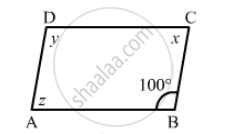
The following figure is parallelogram. Find the degree values of the unknown x, y, z.
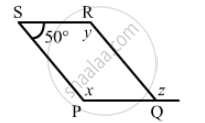
The following figure is parallelogram. Find the degree values of the unknown x, y, z.
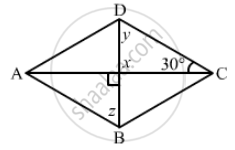
The following figure is parallelogram. Find the degree values of the unknown x, y, z.
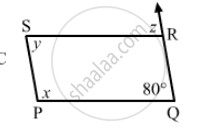
In the following figure RISK and CLUE are parallelograms. Find the measure of x.
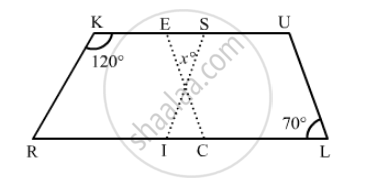
Two adjacent angles of a parallelogram are as 1 : 2. Find the measures of all the angles of the parallelogram.
In a parallelogram ABCD, ∠D = 135°, determine the measure of ∠A and ∠B.
All the angles of a quadrilateral are equal to each other. Find the measure of each. Is the quadrilateral a parallelogram? What special type of parallelogram is it?
Which of the following statement is true for a rhombus?
It has two pairs of equal sides.
Which of the following statement is true for a rhombus?
It has only two pairs of equal sides.
Which of the following statement is true for a rhombus?
Two of its angles are at right angles
Which of the following statement is true for a rhombus?
It has all its sides of equal lengths.
Identify all the quadrilateral that have Four sides of equal length
Draw a rhombus KLMN such that its side is 4 cm and m∠K = 75°.
Lengths of diagonals of a rhombus ABCD are 16 cm and 12 cm. Find the side and perimeter of the rhombus.
The lengths of the diagonals of a Rhombus are 12 cm and 16 cm. Find the side of the rhombus
A rhombus is a parallelogram in which ______ sides are equal.
All rhombuses are squares.
Construct a rhombus whose side is 5 cm and one angle is of 60°.
