Advertisements
Advertisements
Question
Lengths of diagonals of a rhombus ABCD are 16 cm and 12 cm. Find the side and perimeter of the rhombus.
Advertisements
Solution
ABCD is a rhombus.
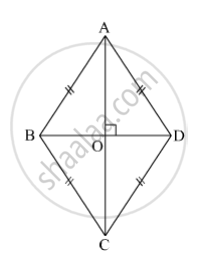
Here, segment AC and segment BD are the diagonals of the rhombus ABCD.
l(AC) = 16 cm and l(BD) = 12 cm.
Diagonals of a rhombus are perpendicular bisectors of each other.
∴ m∠AOD = 90°
Also, l(OA) = `1/2l(AC) = 1/2 xx 16 = 8 cm`
l(OD) = `1/2l(BD) = 1/2`× 12 = 6 cm
In right ∆AOD,
l(AD)2 = l(OA)2 + l(OD)2 ...[Pythagoras theorem]
⇒ l(AD)2 = (8)2 + (6)2
⇒ l(AD)2 = 64 + 36 = 100
⇒ l(AD) = \[\sqrt{100}\] = 10 cm
All sides of a rhombus are equal.
∴ Perimeter of the rhombus ABCD = 4 × Side of a rhombus = 4 × 10 = 40 cm
Thus, the side and perimeter of the rhombus are 10 cm and 40 cm, respectively.
RELATED QUESTIONS
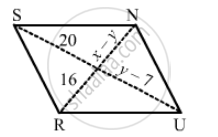
In the following figure GUNS and RUNS are parallelogram. Find x and y.
The sum of two opposite angles of a parallelogram is 130°. Find all the angles of the parallelogram.
Fill in the blank, in the following, so as to make the statement true:
A rhombus is a parallelogram in which ......
Construct a rhombus whose diagonals are of length 10 cm and 6 cm.
In a rhombus PQRS if PQ = 7.5 cm then find QR. If ∠QPS = 75° then find the measure of ∠PQR and ∠SRQ.
Diagonals of a rhombus are 20 cm and 21 cm respectively, then find the side of rhombus and its perimeter.
A quadrilateral whose all sides are equal, opposite angles are equal and the diagonals bisect each other at right angles is a ______.
All rhombuses are squares.
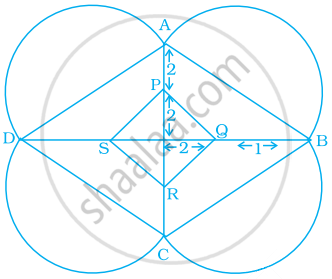
A Rangoli has been drawn on a flor of a house. ABCD and PQRS both are in the shape of a rhombus. Find the radius of semicircle drawn on each side of rhombus ABCD.
ABCD is a rhombus such that the perpendicular bisector of AB passes through D. Find the angles of the rhombus.
Hint: Join BD. Then ∆ABD is equilateral.
