Advertisements
Advertisements
Question
Construct a rhombus whose diagonals are of length 10 cm and 6 cm.
Advertisements
Solution
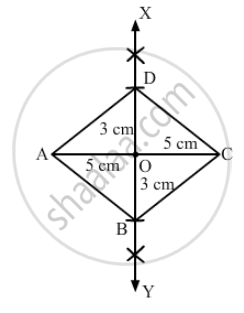
1. Draw AC equal to 10 cm.
2. Draw XY, the right bisector of AC, meeting it at O.
3. With O as centre and radius equal to half of the length of the other diagonal,
i.e. 3 cm, cut OB = OD = 3 cm.
4. Join AB, AD and CB, CD.
RELATED QUESTIONS
Name the quadrilaterals whose diagonals are perpendicular bisectors of each other
Given below is a parallelogram ABCD. Complete each statement along with the definition or property used.
(i) AD =
(ii) ∠DCB =
(iii) OC =
(iv) ∠DAB + ∠CDA =
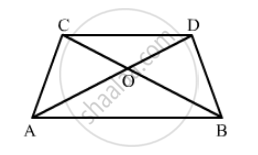
ABCD is a parallelogram in which ∠A = 70°. Compute ∠B, ∠C and ∠D.
Which of the following statement is true for a rhombus?
Its diagonals are equal and perpendicular.
The diagonals of a parallelogram are not perpendicular. Is it a rhombus? Why or why not?
ABCD is a rhombus. If ∠ACB = 40°, find ∠ADB.
Draw a rhombus ABCD, if AB = 6 cm and AC = 5 cm.
The lengths of the diagonals of a Rhombus are 12 cm and 16 cm. Find the side of the rhombus
If the diagonal of a rhombus are equal, then the rhombus is a
Diagonals of a quadrilateral are perpendicular to each other. Is such a quadrilateral always a rhombus? Give a figure to justify your answer.
