Advertisements
Advertisements
प्रश्न
Construct a rhombus whose diagonals are of length 10 cm and 6 cm.
Advertisements
उत्तर
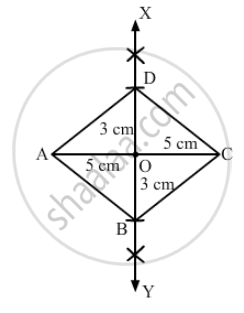
1. Draw AC equal to 10 cm.
2. Draw XY, the right bisector of AC, meeting it at O.
3. With O as centre and radius equal to half of the length of the other diagonal,
i.e. 3 cm, cut OB = OD = 3 cm.
4. Join AB, AD and CB, CD.
संबंधित प्रश्न
The following figure is parallelogram. Find the degree values of the unknown x, y, z.
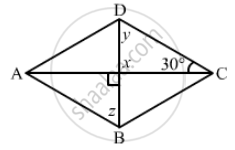
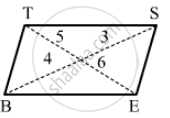
Can the following figure be parallelogram. Justify your answer.
Find the angles marked with a question mark shown in Fig. 17.27
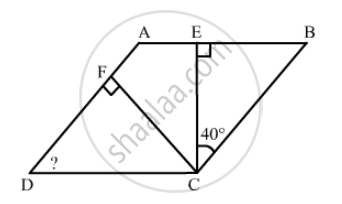
Which of the following statement is true for a rhombus?
It is a quadrilateral.
The diagonals of a quadrilateral are perpendicular to each other. Is such a quadrilateral always a rhombus? If your answer is 'No', draw a figure to justify your answer.
One side of a rhombus is of length 4 cm and the length of an altitude is 3.2 cm. Draw the rhombus.
Draw a rhombus ABCD, if AB = 6 cm and AC = 5 cm.
Which of the following statement is true for a rectangle?
Its diagonals are equal and bisect each other.
Identify all the quadrilateral that have Four sides of equal length
A quadrilateral whose all sides are equal, opposite angles are equal and the diagonals bisect each other at right angles is a ______.
