Advertisements
Advertisements
प्रश्न
If an angle of a parallelogram is two-third of its adjacent angle, find the angles of the parallelogram.
Advertisements
उत्तर
\[\text{ Two adjacent angles of a parallelogram add up to } 180° . \]
\[\text{ Let x be the angle } . \]
\[ \therefore x + \frac{2x}{3} = 180°\]
\[\frac{5x}{3} = = 180°\]
\[x = 72°\]
\[\frac{2x}{3} = \frac{2 \times 72°}{3} = 108°\]
\[\text{Thus, two of the angles in the parallelogram are 108° and the other two are }72° .\]
संबंधित प्रश्न
All rhombuses are parallelograms.
Can the following figure be parallelogram. Justify your answer.
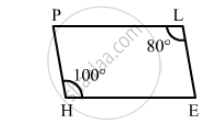
Two adjacent sides of a parallelogram are 4 cm and 3 cm respectively. Find its perimeter.
The diagonals of a quadrilateral are perpendicular to each other. Is such a quadrilateral always a rhombus? If your answer is 'No', draw a figure to justify your answer.
Draw a rhombus, having each side of length 3.5 cm and one of the angles as 40°.
The lengths of the diagonals of a Rhombus are 12 cm and 16 cm. Find the side of the rhombus
If the adjacent sides of a parallelogram are equal then parallelogram is a ______.
If a diagonal of a quadrilateral bisects both the angles, then it is a ______.
A rhombus is a parallelogram in which ______ sides are equal.
A Rangoli has been drawn on a flor of a house. ABCD and PQRS both are in the shape of a rhombus. Find the radius of semicircle drawn on each side of rhombus ABCD.