Advertisements
Advertisements
प्रश्न
If a diagonal of a quadrilateral bisects both the angles, then it is a ______.
पर्याय
kite
parallelogram
rhombus
rectangle
Advertisements
उत्तर
If a diagonal of a quadrilateral bisects both the angles, then it is a rhombus.
Explanation:
A parallelogram is a quadrilateral whose diagonal bisects both angles. It is also true for rhombus and rectangle but in a rhombus all the sides are also equal and in a rectangle all the angles are also equal.
APPEARS IN
संबंधित प्रश्न
In the following figure GUNS and RUNS are parallelogram. Find x and y.
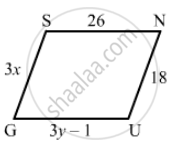
In the following figure GUNS and RUNS are parallelogram. Find x and y.
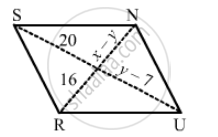
In the following figure RISK and CLUE are parallelograms. Find the measure of x.
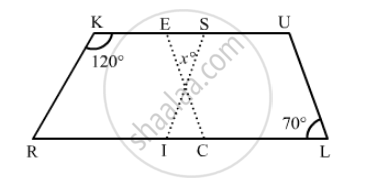
ABCD is a rhombus. If ∠ACB = 40°, find ∠ADB.
Construct a rhombus whose diagonals are of length 10 cm and 6 cm.
Which of the following statement is true for a rectangle?
Its diagonals are equal and bisect each other.
Lengths of diagonals of a rhombus ABCD are 16 cm and 12 cm. Find the side and perimeter of the rhombus.
If the adjacent sides of a parallelogram are equal then parallelogram is a ______.
All rhombuses are squares.
ABCD is a rhombus such that the perpendicular bisector of AB passes through D. Find the angles of the rhombus.
Hint: Join BD. Then ∆ABD is equilateral.
