Advertisements
Advertisements
प्रश्न
ABCD is a rhombus such that the perpendicular bisector of AB passes through D. Find the angles of the rhombus.
Hint: Join BD. Then ∆ABD is equilateral.
Advertisements
उत्तर
Let ABCD be a rhombus where DE is perpendicular bisector of AB.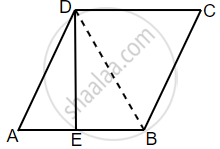
Construction: Join BD.
Now, in triangle AED and triangle BED:
AE = EB
ED = ED ...[Common side]
∠AED = ∠DEB = 90°
Now, using SAS rule,
ΔAED ≅ ΔBED
AD = DB = AB ...[ABCD is a rhombus. So, AD = AB]
Hence, triangle ADB is an equilateral triangle.
So, ∠DAB = ∠DBA = ∠ADB = 60°
∴ ∠DCB = 60° ...[Opposite angles of a rhombus are equal]
Now, ∠DAB + ∠ABC = 180° ...[Adjacent angles of a rhombus are supplementary]
⇒ 60° + ∠ABD + ∠DBC = 180°
⇒ 60° + 60° + ∠DBC = 180°
⇒ ∠DBC = 60°
⇒ ∠ABC = ∠ABD + ∠DBC = 60° + 60° = 120°
∴ ∠ADC = 120° ...[Opposite angles of a rhombus are equal]
Hence, the angles of the rhombus are 60°, 120°, 60°, 120°.
APPEARS IN
संबंधित प्रश्न
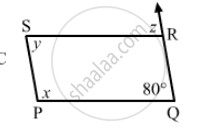
The following figure is parallelogram. Find the degree values of the unknown x, y, z.
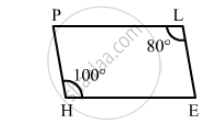
Can the following figure be parallelogram. Justify your answer.
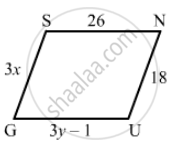
In the following figure GUNS and RUNS are parallelogram. Find x and y.
Which of the following statement is true for a rhombus?
It is a quadrilateral.
The diagonals of a parallelogram are not perpendicular. Is it a rhombus? Why or why not?
The diagonals of a quadrilateral are perpendicular to each other. Is such a quadrilateral always a rhombus? If your answer is 'No', draw a figure to justify your answer.
ABCD is a rhombus and its diagonals intersect at O.
(i) Is ∆BOC ≅ ∆DOC? State the congruence condition used?
(ii) Also state, if ∠BCO = ∠DCO.
State with reason whether the following statement is ‘true’ or ‘false’.
Every parallelogram is a rhombus.
If all pairs of adjacent sides of a quadrilateral are congruent then it is called ______.
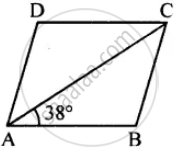
ABCD is a rhombus. If ∠BAC = 38°, find :
(i) ∠ACB
(ii) ∠DAC
(iii) ∠ADC.