Advertisements
Advertisements
प्रश्न
The diagonals of a quadrilateral are of lengths 6 cm and 8 cm. If the diagonals bisect each other at right angles, what is the length of each side of the quadrilateral?
Advertisements
उत्तर
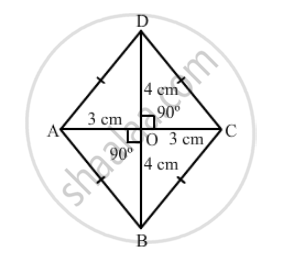
\[\text{ Let the given quadrilateral be ABCD in which diagonals AC is equal to 6 cm and BD is equal to 8 cm }. \]
\[\text{ Also, it is given that the diagonals bisect each other at right angle, at point O }. \]
\[ \therefore AO = OC = \frac{1}{2}AC = 3 cm\]
\[\text{ Also }, OB = OD = \frac{1}{2}BD = 4 cm\]
\[\text{ In right }\bigtriangleup AOB: \]
\[ {AB}^2 = {OA}^2 + {OB}^2 \]
\[ \Rightarrow {AB}^2 = (9 + 16) {cm}^2 \]
\[ \Rightarrow {AB}^2 = 25 {cm}^2 \]
\[ \Rightarrow AB = 5 cm\]
\[\text{ Thus, the length of each side of the quadrilateral is 5 cm } . \]
\[\]
संबंधित प्रश्न
All rhombuses are parallelograms.
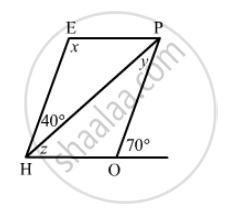
In the adjacent figure HOPE is a parallelogram. Find the angle measures x,y and z. State the geometrical truths you use to find them.
The measure of one angle of a parallelogram is 70°. What are the measures of the remaining angles?
The perimeter of a parallelogram is 150 cm. One of its sides is greater than the other by 25 cm. Find the length of the sides of the parallelogram.
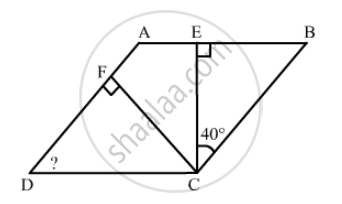
Find the angles marked with a question mark shown in Fig. 17.27
Which of the following statement is true for a rhombus?
It has two pairs of parallel sides.
Which of the following statement is true for a rhombus?
It can be a square.
Which of the following statement is true for a rhombus?
It is a square.
The diagonals of a parallelogram are not perpendicular. Is it a rhombus? Why or why not?
Construct a rhombus CLUE in which CL = 7.5 cm and LE = 6 cm.
