Advertisements
Advertisements
प्रश्न
ABCD is a rhombus whose diagonals intersect at O. If AB = 10 cm, diagonal BD = 16 cm, find the length of diagonal AC.
Advertisements
उत्तर
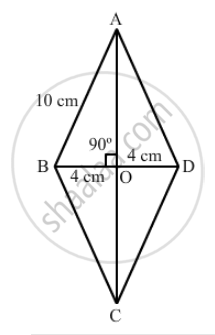
\[\text{ We know that the diagonals of a rhombus bisect each other at right angles }. \]
\[ \therefore BO = \frac{1}{2}BD = (\frac{1}{2} \times 16) cm\]
\[ = 8cm\]
\[AB = 10 \text{ cm and }\angle AOB = 90°\]
\[\text{ From right } ∆ OAB: \]
\[ {AB}^2 = {AO}^2 + {BO}^2 \]
\[ \Rightarrow {AO}^2 = ( {AB}^2 -{BO}^2 )\]
\[ \Rightarrow {AO}^2 = (10 )^2 - (8 )^2 {cm}^2 \]
\[ \Rightarrow {AO}^2 = (100 - 64) {cm}^2 = 36 {cm}^2 \]
\[ \Rightarrow AO = \sqrt{36} cm = 6cm\]
\[ \therefore AC = 2 \times AO = (2 \times 6) cm = 12 cm\]
संबंधित प्रश्न
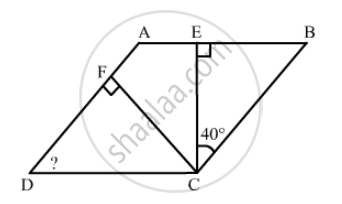
Find the angles marked with a question mark shown in Fig. 17.27
Which of the following statement is true for a rhombus?
Two of its angles are at right angles
Which of the following statement is true for a rhombus?
Its diagonals bisect each other at right angles.
Which of the following statement is true for a rhombus?
It is a parallelogram.
Fill in the blank, inthe following, so as to make the statement true:
A square is a rhombus in which .....
One side of a rhombus is of length 4 cm and the length of an altitude is 3.2 cm. Draw the rhombus.
Measure of one angle of a rhombus is 50°, find the measures of remaining three angles.
All rhombuses are squares.
Diagonals of a quadrilateral are perpendicular to each other. Is such a quadrilateral always a rhombus? Give a figure to justify your answer.
Construct a rhombus whose side is 5 cm and one angle is of 60°.
