Advertisements
Advertisements
प्रश्न
Show that each diagonal of a rhombus bisects the angle through which it passes.
Advertisements
उत्तर

\[\text{ In ∆ AED and ∆ DEC }: \]
\[ AE = EC (\text{ diagonals bisect each other })\]
\[AD = DC (\text{ sides are equal })\]
\[DE = DE (\text{ common })\]
\[\text{ By SSS congruence }: \]
\[ ∆ AED \cong ∆ CED\]
\[\angle ADE = \angle CDE (\text{ c . p . c . t })\]
\[\text{ Similarly, we can prove ∆ AEB and ∆ BEC, ∆ BEC and ∆ DEC, ∆ AED and ∆ AEB are congruent to each other } . \]
\[\text{ Hence, diagonal of a rhombus bisects the angle through which it passes } . \]
\[\]
संबंधित प्रश्न
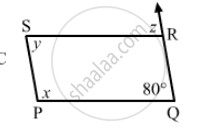
The following figure is parallelogram. Find the degree values of the unknown x, y, z.
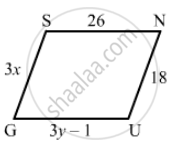
In the following figure GUNS and RUNS are parallelogram. Find x and y.
If an angle of a parallelogram is two-third of its adjacent angle, find the angles of the parallelogram.
Which of the following statement is true for a rhombus?
It has all its sides of equal lengths.
ABCD is a rhombus. If ∠ACB = 40°, find ∠ADB.
If the diagonals of a rhombus are 12 cm and 16cm, find the length of each side.
In a rhombus PQRS if PQ = 7.5 cm then find QR. If ∠QPS = 75° then find the measure of ∠PQR and ∠SRQ.
Draw a rhombus KLMN such that its side is 4 cm and m∠K = 75°.
If the diagonal of a rhombus are equal, then the rhombus is a
All rhombuses are squares.
