Advertisements
Advertisements
प्रश्न
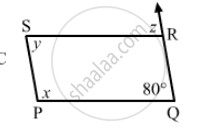
The following figure is parallelogram. Find the degree values of the unknown x, y, z.
Advertisements
उत्तर
\[\text{ Opposite angles are equal in a parallelogram } . \]
\[ \therefore y = 80°\]
\[y + x = 180° \]
\[x = 180° - 100°= 80°\]
\[z = y = 80° (\text{ alternate angles })\]
संबंधित प्रश्न
Name the quadrilaterals whose diagonals are perpendicular bisectors of each other
Two opposite angles of a parallelogram are (3x − 2)° and (50 − x)°. Find the measure of each angle of the parallelogram.
The sum of two opposite angles of a parallelogram is 130°. Find all the angles of the parallelogram.
The perimeter of a parallelogram is 150 cm. One of its sides is greater than the other by 25 cm. Find the length of the sides of the parallelogram.
Points E and F lie on diagonal AC of a parallelogram ABCD such that AE = CF. What type of quadrilateral is BFDE?
Which of the following statement is true for a rhombus?
Its diagonals are equal and perpendicular.
Which of the following statement is true for a rhombus?
It is a quadrilateral.
In rhombus ABCD;
(i) if ∠A = 74° ; find ∠B and ∠C.
(ii) if AD = 7.5 cm ; find BC and CD.
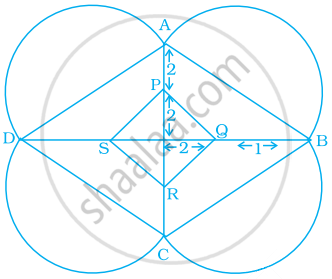
A Rangoli has been drawn on a flor of a house. ABCD and PQRS both are in the shape of a rhombus. Find the radius of semicircle drawn on each side of rhombus ABCD.
Construct a rhombus CLUE in which CL = 7.5 cm and LE = 6 cm.
