Advertisements
Advertisements
Question
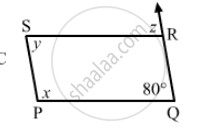
The following figure is parallelogram. Find the degree values of the unknown x, y, z.
Advertisements
Solution
\[\text{ Opposite angles are equal in a parallelogram } . \]
\[ \therefore y = 80°\]
\[y + x = 180° \]
\[x = 180° - 100°= 80°\]
\[z = y = 80° (\text{ alternate angles })\]
RELATED QUESTIONS
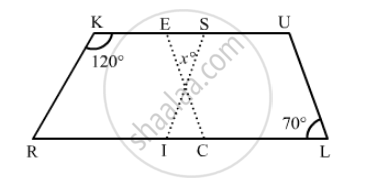
In the following figure RISK and CLUE are parallelograms. Find the measure of x.
Two adjacent angles of a parallelogram are as 1 : 2. Find the measures of all the angles of the parallelogram.
The sum of two opposite angles of a parallelogram is 130°. Find all the angles of the parallelogram.
Which of the following statement is true for a rhombus?
It has two pairs of equal sides.
Which of the following statement is true for a rhombus?
Its diagonals are equal and perpendicular.
Which of the following statement is true for a rhombus?
It is a quadrilateral.
The diagonals of a quadrilateral are perpendicular to each other. Is such a quadrilateral always a rhombus? If your answer is 'No', draw a figure to justify your answer.
Draw a rhombus ABCD, if AB = 6 cm and AC = 5 cm.
If opposite angles of a rhombus are (2x)° and (3x - 40)° then value of x is ______.
If the diagonal of a rhombus are equal, then the rhombus is a
