Advertisements
Advertisements
Question
The diagonals of a quadrilateral are perpendicular to each other. Is such a quadrilateral always a rhombus? If your answer is 'No', draw a figure to justify your answer.
Advertisements
Solution

RELATED QUESTIONS
All rhombuses are parallelograms.
The following figure is parallelogram. Find the degree values of the unknown x, y, z.

In the adjacent figure HOPE is a parallelogram. Find the angle measures x,y and z. State the geometrical truths you use to find them.
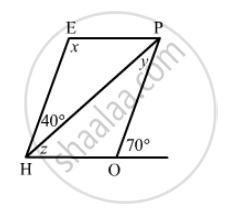
Find the angles marked with a question mark shown in Fig. 17.27
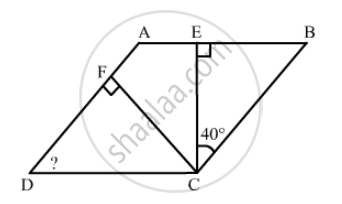
Fill in the blank, in the following, so as to make the statement true:
The diagonals of a rhombus ...... each other at ...... angles.
Diagonals of a parallelogram intersect each other at point O. If AO = 5, BO = 12 and AB = 13 then show that `square`ABCD is a rhombus.
Measure of one angle of a rhombus is 50°, find the measures of remaining three angles.
ABCD is a rhombus. If ∠BCA = 35°. find ∠ADC.
All rhombuses are squares.
Construct a rhombus CLUE in which CL = 7.5 cm and LE = 6 cm.
