Advertisements
Advertisements
Question
Which of the following statement is true for a rhombus?
It has all its sides of equal lengths.
Advertisements
Solution
True
RELATED QUESTIONS
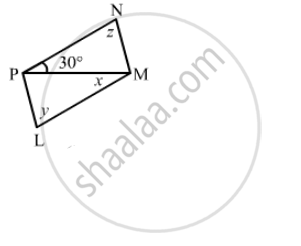
The following figure is parallelogram. Find the degree values of the unknown x, y, z.
The diagonals of a quadrilateral are perpendicular to each other. Is such a quadrilateral always a rhombus? If your answer is 'No', draw a figure to justify your answer.
If the diagonals of a rhombus are 12 cm and 16cm, find the length of each side.
Construct a rhombus whose diagonals are of length 10 cm and 6 cm.
Draw a rhombus, having each side of length 3.5 cm and one of the angles as 40°.
Show that each diagonal of a rhombus bisects the angle through which it passes.
Diagonals of a parallelogram intersect each other at point O. If AO = 5, BO = 12 and AB = 13 then show that `square`ABCD is a rhombus.
Diagonals of a rhombus are 20 cm and 21 cm respectively, then find the side of rhombus and its perimeter.
Diagonals PR and QS of a rhombus PQRS are 20 cm and 48 cm respectively. Find the length of side PQ.
Lengths of diagonals of a rhombus ABCD are 16 cm and 12 cm. Find the side and perimeter of the rhombus.
