Advertisements
Advertisements
Question
Draw a rhombus, having each side of length 3.5 cm and one of the angles as 40°.
Advertisements
Solution

1. Draw a line segment AB of 3.5 cm.
2. Draw \[\angle\] BAX equal to 40\[°\]
3. With A as centre and the radius equal to AB, cut AD at 3.5 cm.
4. With D as centre, cut an arc of radius 3.5 cm.
5. With B as centre, cut an arc of radius 3.5 cm. This arc cuts the arc of step 4 at C.
6. Join DC and BC.
RELATED QUESTIONS
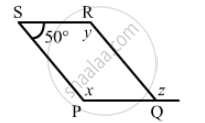
The following figure is parallelogram. Find the degree values of the unknown x, y, z.
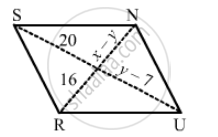
In the following figure GUNS and RUNS are parallelogram. Find x and y.
In a parallelogram ABCD, ∠D = 135°, determine the measure of ∠A and ∠B.
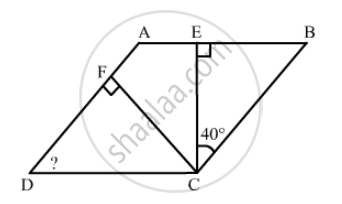
Find the angles marked with a question mark shown in Fig. 17.27
Which of the following statement is true for a rhombus?
It has two pairs of equal sides.
Which of the following statement is true for a rhombus?
Two of its angles are at right angles
If all pairs of adjacent sides of a quadrilateral are congruent then it is called ______.
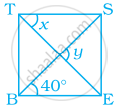
In the figure, BEST is a rhombus, Then the value of y – x is ______.
If all sides of a quadrilateral are equal, it is a ______.
Construct a rhombus whose side is 5 cm and one angle is of 60°.
