Advertisements
Advertisements
प्रश्न
Draw a rhombus, having each side of length 3.5 cm and one of the angles as 40°.
Advertisements
उत्तर

1. Draw a line segment AB of 3.5 cm.
2. Draw \[\angle\] BAX equal to 40\[°\]
3. With A as centre and the radius equal to AB, cut AD at 3.5 cm.
4. With D as centre, cut an arc of radius 3.5 cm.
5. With B as centre, cut an arc of radius 3.5 cm. This arc cuts the arc of step 4 at C.
6. Join DC and BC.
संबंधित प्रश्न
Can the following figure be parallelogram. Justify your answer.
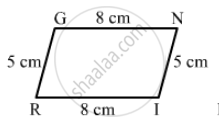
Can the following figure be parallelogram. Justify your answer.
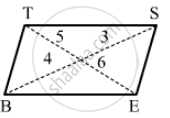
The measure of one angle of a parallelogram is 70°. What are the measures of the remaining angles?
All the angles of a quadrilateral are equal to each other. Find the measure of each. Is the quadrilateral a parallelogram? What special type of parallelogram is it?
Which of the following statement is true for a rhombus?
It has only two pairs of equal sides.
Which of the following statement is true for a rhombus?
Its diagonals are equal and perpendicular.
Draw a rhombus ABCD, if AB = 6 cm and AC = 5 cm.
Diagonals of a rhombus are 20 cm and 21 cm respectively, then find the side of rhombus and its perimeter.
If a diagonal of a quadrilateral bisects both the angles, then it is a ______.
Construct a rhombus whose side is 5 cm and one angle is of 60°.
