Advertisements
Advertisements
प्रश्न
Draw a rhombus KLMN such that its side is 4 cm and m∠K = 75°.
Advertisements
उत्तर
Steps of Construction:
Step 1: Draw KL = 4 cm.
Step 2: Draw ∠LKX = 75º.
Step 3: With K as the centre and radius of 4 cm, draw an arc cutting the ray KX at N.
Step 4: With N as centre and radius 4 cm, draw an arc.
Step 5: With L as the center and a radius of 4 cm, draw an arc cutting the previous arc at M.
Step 6: Join LM and NM.
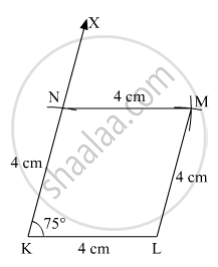
Here, KLMN is the required rhombus.
संबंधित प्रश्न
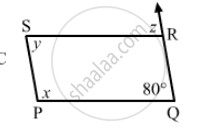
The following figure is parallelogram. Find the degree values of the unknown x, y, z.
If an angle of a parallelogram is two-third of its adjacent angle, find the angles of the parallelogram.
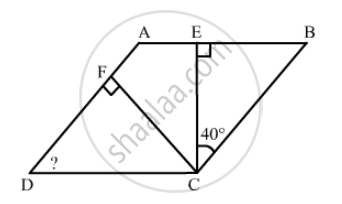
Find the angles marked with a question mark shown in Fig. 17.27
Which of the following statement is true for a rhombus?
It has only two pairs of equal sides.
Fill in the blank, in the following, so as to make the statement true:
A rhombus is a parallelogram in which ......
Fill in the blank, inthe following, so as to make the statement true:
A rhombus has all its sides of ...... length.
The diagonals of a parallelogram are not perpendicular. Is it a rhombus? Why or why not?
Draw a rhombus ABCD, if AB = 6 cm and AC = 5 cm.
State with reason whether the following statement is ‘true’ or ‘false’.
Every rhombus is a rectangle.
Construct a rhombus CLUE in which CL = 7.5 cm and LE = 6 cm.
