Advertisements
Advertisements
प्रश्न
Fill in the blank, inthe following, so as to make the statement true:
A rhombus has all its sides of ...... length.
Advertisements
उत्तर
A rhombus has all its sides of equal length.
संबंधित प्रश्न
Name the quadrilaterals whose diagonals are perpendicular bisectors of each other
Can the following figure be parallelogram. Justify your answer.
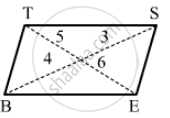
Two adjacent angles of a parallelogram are as 1 : 2. Find the measures of all the angles of the parallelogram.
The sum of two opposite angles of a parallelogram is 130°. Find all the angles of the parallelogram.
Which of the following statement is true for a rhombus?
It has two pairs of parallel sides.
Which of the following statement is true for a rhombus?
It is a parallelogram.
Fill in the blank, inthe following, so as to make the statement true:
A square is a rhombus in which .....
The diagonals of a quadrilateral are perpendicular to each other. Is such a quadrilateral always a rhombus? If your answer is 'No', draw a figure to justify your answer.
A rhombus is a parallelogram in which ______ sides are equal.
All rhombuses are squares.
