Advertisements
Advertisements
प्रश्न
Which of the following statement is true for a rhombus?
It has two pairs of parallel sides.
Advertisements
उत्तर
True
संबंधित प्रश्न
Two opposite angles of a parallelogram are (3x − 2)° and (50 − x)°. Find the measure of each angle of the parallelogram.
If an angle of a parallelogram is two-third of its adjacent angle, find the angles of the parallelogram.
Which of the following statement is true for a rhombus?
It is a quadrilateral.
Fill in the blank, inthe following, so as to make the statement true:
A square is a rhombus in which .....
Fill in the blank, in the following, so as to make the statement true:
The diagonals of a rhombus ...... each other at ...... angles.
Show that each diagonal of a rhombus bisects the angle through which it passes.
In a rhombus PQRS if PQ = 7.5 cm then find QR. If ∠QPS = 75° then find the measure of ∠PQR and ∠SRQ.
The given figure shows a rhombus ABCD in which angle BCD = 80°. Find angles x and y.
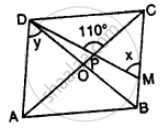
In a rhombus diagonals intersect at ______ angles.
ABCD is a rhombus such that the perpendicular bisector of AB passes through D. Find the angles of the rhombus.
Hint: Join BD. Then ∆ABD is equilateral.
