Advertisements
Advertisements
प्रश्न
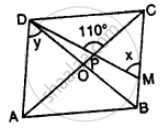
The given figure shows a rhombus ABCD in which angle BCD = 80°. Find angles x and y.
Advertisements
उत्तर
In rhombus ABCD, diagonals AC and BD bisect each other at 90°
∠BCD = 80°
Diagonals bisect the opposite angles also ∠BCD =
∠BAD (Opposite angles of rhombus)
∠BAD = 80° and ∠ABC = ∠ADC = 180° – 80° = 100°
Diagonals bisect opposite angles
∠OCB or ∠PCB =`80^circ/2` = 40°
In ∆PCM,
Ext. CPD = ∠OCB + ∠PMC
110° = 40° + x
⇒ x = 110° – 40° = 70°
and ∠ADO = `1/2` ∠ADC = `1/2 xx 100^circ = 50^circ`
Hence x = 70° and y = 50°
APPEARS IN
संबंधित प्रश्न
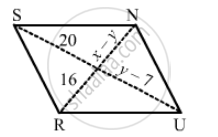
In the following figure GUNS and RUNS are parallelogram. Find x and y.
In a parallelogram ABCD, AB = 10 cm, AD = 6 cm. The bisector of ∠A meets DC in E, AEand BC produced meet at F. Find te length CF.
Which of the following statement is true for a rhombus?
Two of its angles are at right angles
Which of the following statement is true for a rhombus?
Its diagonals are equal and perpendicular.
Identify all the quadrilateral that have Four sides of equal length
In a rhombus PQRS if PQ = 7.5 cm then find QR. If ∠QPS = 75° then find the measure of ∠PQR and ∠SRQ.
If opposite angles of a rhombus are (2x)° and (3x - 40)° then value of x is ______.
Lengths of diagonals of a rhombus ABCD are 16 cm and 12 cm. Find the side and perimeter of the rhombus.
In a rhombus diagonals intersect at ______ angles.
ABCD is a rhombus such that the perpendicular bisector of AB passes through D. Find the angles of the rhombus.
Hint: Join BD. Then ∆ABD is equilateral.
