Advertisements
Advertisements
प्रश्न
In a parallelogram ABCD, AB = 10 cm, AD = 6 cm. The bisector of ∠A meets DC in E, AEand BC produced meet at F. Find te length CF.
Advertisements
उत्तर
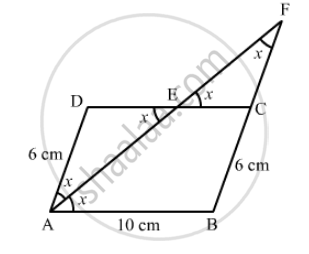
\[\text{ AE is the bisector of } \angle A . \]
\[ \therefore \angle DAE = \angle BAE = x\]
\[ \angle BAE = \angle AED = x (\text{ alternate angles })\]
\[\text{ Since opposite angles in ∆ ADE are equal, ∆ ADE is an isosceles triangle } . \]
\[ \therefore AD = DE = 6 cm (\text{ sides opposite to equal angles })\]
\[AB = CD = 10 cm \]
\[CD = DE + EC\]
\[ \Rightarrow EC = CD - DE\]
\[ \Rightarrow EC = 10 - 6 = 4 cm\]
\[\angle DEA = \angle CEF = x (\text{ vertically opposite angle })\]
\[\angle EAD = \angle EFC = x (\text{ alternate angles })\]
\[\text{ Since opposite angles in } ∆ EFC \text{ are equal, ∆ EFC is an isosceles triangle } . \]
\[ \therefore CF = CE = 4 \text{ cm (sides opposite to equal angles })\]
\[ \therefore CF = 4\text{ cm }\]
संबंधित प्रश्न
The following figure is parallelogram. Find the degree values of the unknown x, y, z.
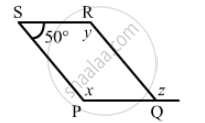
The following figure is parallelogram. Find the degree values of the unknown x, y, z.
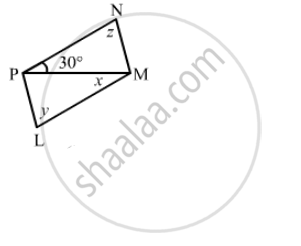
The following figure is parallelogram. Find the degree values of the unknown x, y, z.
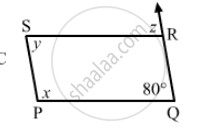
The following figure is parallelogram. Find the degree value of the unknown x, y, z.
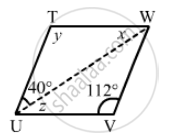
Which of the following statement is true for a rhombus?
It has two pairs of parallel sides.
Which of the following statement is true for a rhombus?
It is a quadrilateral.
Fill in the blank, inthe following, so as to make the statement true:
A square is a rhombus in which .....
Show that each diagonal of a rhombus bisects the angle through which it passes.
State with reason whether the following statement is ‘true’ or ‘false’.
Every rhombus is a rectangle.
The given figure shows a rhombus ABCD in which angle BCD = 80°. Find angles x and y.